
Compare and get personalised quotes from 19 life insurance providers to find the best retirement annuity endowment plan in Singapore for your needs.
How a Retirement Annuity Plan Works
A retirement annuity plan is an insurance policy that pays you a regular income, usually monthly, from a retirement age you choose, for a fixed number of years or for life. You pay premiums during your working years, either as one lump sum or in regular instalments, let the money grow, and then draw on it in retirement. Each payout is made up of a guaranteed amount and a non-guaranteed bonus.
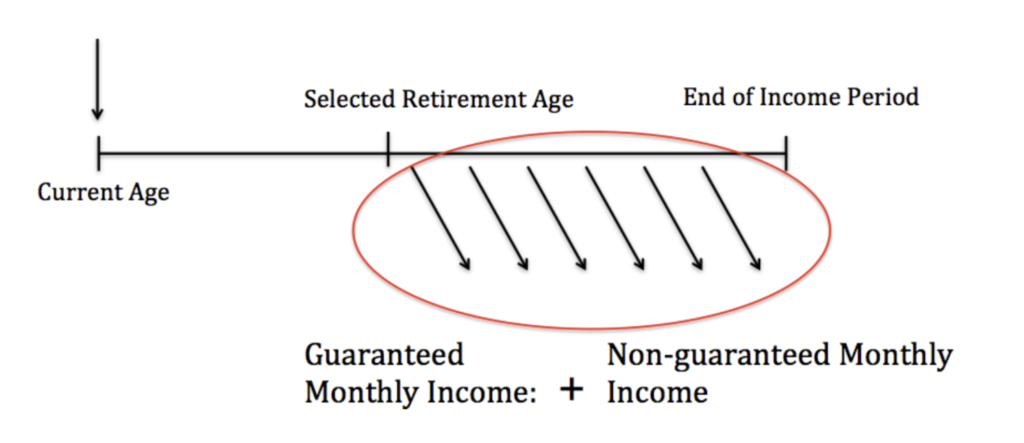
Your premiums go into the insurer’s participating fund, which is invested on your behalf. The insurer, not you, carries the risk of the fund having a bad year. Part of your payout is guaranteed by the insurer, and the bonuses come on top of that. Treat the bonus figures in a benefit illustration as scenarios, not promises.
Three features make these plans appealing to conservative savers:
- Some form of guarantee on your money, as long as you hold the plan to the end (early surrender is a different story, and usually means getting back less than you paid)
- A guaranteed income you can plan your retirement around, with non-guaranteed bonuses on top
- Guaranteed acceptance on most plans, with no medical check-up, because the life cover is deliberately kept small so that almost all of your premium goes towards growing your money
The policy is also covered by the Policy Owners’ Protection Scheme administered by SDIC, subject to caps, in the unlikely event the insurer fails.
Why Buy One When You Already Have CPF LIFE?
A private retirement annuity plan is not a replacement for CPF LIFE. It is a layer on top of it.
CPF LIFE already pays every member a monthly income for life, starting from 65 by default (you can defer it to as late as 70 for higher payouts), and it is backed by the Government. No private plan matches it on either point. The question is whether that income will be enough.
For members turning 55 in 2026, CPF LIFE payouts from 65 range from around $950 a month with the Basic Retirement Sum to around $3,440 a month with the Enhanced Retirement Sum. Set that against the $1,384 a month the average retiree household spends per person (Household Expenditure Survey 2023), and the Full Retirement Sum payout of around $1,780 looks comfortable on paper.
But that $1,384 is today’s spending. If you are 35 now, you have 30 years of inflation between you and retirement. At 2% a year, roughly the long-run average in Singapore, the same lifestyle would cost about $2,500 a month by the time you reach 65, and it keeps rising through retirement. The retirement sums are raised each year to keep pace, but only if you actually hit them.
In my opinion, CPF LIFE is best treated as your income floor, the layer that covers essentials. Everything above that, whether travel, helping your children, or simply keeping your current lifestyle, has to come from the rest of your retirement plan. Our retirement calculator will give you a rough figure for how big that gap is.
A private annuity fills the gap in four situations:
- Topping up the floor. A plan paying a fixed sum each month from 65, alongside CPF LIFE, closes the difference between what CPF gives you and what you actually want to spend.
- Bridging the years before 65. CPF LIFE cannot start before 65, but plenty of people stop work earlier, by choice or because of health. A private plan can start paying at 55 or 60 and help cover those years.
- Keeping part of your savings out of the market. If most of your retirement money is in shares, a downturn in the year you retire can force you to sell at a loss. A plan with guaranteed payouts gives you a portion that is less exposed to that, provided you hold it to the end.
- Locking in gains as you get older. Most people shift from riskier investments towards safer ones as retirement approaches, the same idea as rebalancing a portfolio. If your shares or other higher-risk investments have done well, moving part of those gains into a retirement annuity plan converts them into an income stream with a guaranteed component, so a later downturn has less effect on the growth you have already made on that portion.
There is also a tax angle. Contributing to your SRS account is what earns you the income tax relief, and buying an annuity with a single premium is simply what you do with the money once it’s in there. The payouts flow back into SRS, where only half of each withdrawal is taxable from statutory retirement age. We cover that on our separate SRS annuity comparison page.
Five Decisions That Shape Your Plan
Retirement annuity plans are flexible, which is a strength and a source of confusion. These five settings decide almost everything about what you pay and what you get back.
1) Single or regular premium
Single premium means putting in one lump sum. Regular premium spreads it over a set number of years, paid monthly or yearly.
With all else equal, a single premium tends to give better returns, because the whole amount starts compounding from day one. But a lump sum of that size isn’t feasible for most people, which is why regular premium plans are far more common. If you do pay regularly, paying yearly rather than monthly usually earns a small discount or slightly better figures.
SRS funds can only be used for single premium plans.
2) How long you pay for
Premium terms usually run five, 10, 15, or 20 years if you’re paying regularly. The shortest term isn’t always the best. At the same monthly budget, a five-year term simply accumulates less than a 20-year one, and you may end up with a smaller income than you need. Match the term to the working years you have left, and give yourself some room so that the plan doesn’t stretch into retirement itself.
3) When payouts start
Most plans let you choose a retirement age of 50, 55, 60, 65, or 70, and are built for people who are still 10 to 30 years away from it.
The choice comes back to the previous section. Payouts before 65 bridge the gap before CPF LIFE. Payouts from 65 top it up.
4) How much of the income is guaranteed
Compare plans on the guaranteed monthly income first, for the same premium and the same payout period. Non-guaranteed bonuses can be significant, and insurers have every reason to keep paying them, but they can vary with the fund’s performance. It helps to know how much of the projected income you would still receive if the bonuses came in lower than illustrated.
5) How long the payouts run
Depending on the plan, you can choose 10, 15, or 20 years, and some pay for life (to age 100 or 120). The longer the payout period, the lower the monthly income for the same premium.
A shorter payout period is not a weakness. CPF LIFE already covers “for life”, so a private plan doesn’t need to. Most people pick 10 or 20 years and take a higher monthly income in the early years of retirement, which is when you tend to spend the most: travelling, taking up hobbies, treating the grandchildren. Spending usually tapers off in the later years, when health limits what you can do, and CPF LIFE is still there to cover the essentials. WHO estimates put Singapore’s healthy life expectancy at 73.6 years in 2021, against an overall life expectancy of 83.2 years that year, so close to 10 years are typically spent in poorer health.
Are Retirement Annuity Plans Worth It?
A retirement annuity plan is worth considering if you want part of your retirement income to be predictable and to come with some form of guarantee, and you can leave the money untouched until the payouts start. It is a poor fit if you might need the money early, or if the highest possible return is your main goal.
The case for
- Balance. Bank deposits are safe and liquid, but inflation, which averaged 2.14% a year over the past 20 years, quietly eats into them. Shares grow faster but swing, and take time to manage. An annuity sits in between, with guaranteed payouts, bonuses on top, and nothing for you to do once it is set up.
- Predictability. Retirement arrives on a date, and you will need income for a known stretch after it. A plan turns a lump sum into a schedule, which is easier to build a budget around than a portfolio you may have to sell into a downturn.
- Tailored to you. Budget, premium term, retirement age, and payout period are all adjustable, so the same plan can suit someone starting at 30 and someone starting at 50.
- No health questions. Because the insurance element is minimal, most plans are issued without underwriting, which matters if you have a pre-existing condition. Do make sure your protection is properly in place first, though. An annuity is a savings tool, not a substitute for life or critical illness cover.
The case against
- Early surrender loses money. These plans are built to be held for the long term. Surrender in the early years and you will usually get back less than you paid. Don’t overcommit, and keep an emergency fund outside the plan.
- The bonuses are not guaranteed. What you eventually receive could be lower than the figures in the benefit illustration if the participating fund underperforms.
- The returns are modest. Combined guaranteed and non-guaranteed returns typically come to around 2% to 3.5% a year, depending on the plan and how long it accumulates and pays out. That is below what shares have returned historically, and it is the trade-off for the guarantees.
Best Retirement Annuity Plans in Singapore (Comparison for 2026)
Here’s a non-exhaustive list of retirement annuity plans that we can compare:
| Insurance Company | Plan Name |
|---|---|
| Singlife | Flexi Retirement II |
| Manulife | RetireReady Plus (III) |
| Income Insurance | Gro Retire Flex Pro II |
| China Taiping | i-Retire (II) |

Singlife Flexi Retirement II
Singlife Flexi Retirement II is a participating plan for people who want to set their own retirement income and shape the plan around it, rather than pick from a fixed menu. You choose a guaranteed monthly income of at least $300, and Singlife works out the premium. Premiums can be paid as a single lump sum or spread over five, 10, 15, 20, or 25 years.
Payouts can run for as little as five years or all the way to age 120, and you can pick any whole number of years in between. If your plans change, you have until three months before the first payout to lengthen or shorten the payout period.
On regular premium policies, premiums are waived if you become totally and permanently disabled. An optional rider, Singlife Care Income Plus Cover, adds a separate monthly care income if you are unable to perform at least two of the six activities of daily living during the payout years, with the choice of taking it as one lump sum instead.

Income Insurance Gro Retire Flex Pro II
Income Insurance Gro Retire Flex Pro II is a participating endowment plan whose main selling point is flexibility over when your retirement actually begins. Premiums can be paid as a lump sum or over five, 10, 15, or 20 years. The accumulation period, during which your savings build up before any income is paid, can be set anywhere from five to 50 years on a single premium policy, or 10 to 50 years on a regular premium one.
Once the accumulation period ends, a guaranteed monthly cash benefit and a non-guaranteed monthly cash bonus are paid for 10, 15, or 20 years, or until age 100. The age 100 option is only available if your age at entry plus the accumulation period comes to 50 or more. The payout period can be changed once, no earlier than two years into the policy and no later than 30 days before the first payout.
The feature that Income highlights most is the Flexi Retire Option, which it describes as a first in Singapore. It lets you move the start of your payouts earlier or later by up to five years, provided you exercise it once, at least two years after buying the plan and at least two years before the accumulation period was due to end.
Regular premium policies carry a compulsory rider, the Gro Retire Flex Pro II Protection Benefit, which bundles three covers: an extra 105% of premiums paid on accidental death before age 70, a lump sum of 12 times the monthly cash benefit plus a waiver of future premiums on four specified disabilities (loss of use of one limb, irreversible loss of speech, loss of sight in one eye, or deafness), and a six-month premium waiver on retrenchment once you have been out of work for three months, with the option to defer premiums for another six months after that. Terms and conditions apply.
The death benefit is 105% of premiums paid or the guaranteed cash value, whichever is higher.

Manulife RetireReady Plus (III)
Manulife RetireReady Plus (III) is a participating retirement plan that lets you fix your guaranteed monthly income (from $250), your premium term, your retirement age, and your payout period in four separate choices. Premiums can be a single payment or spread over five, 10, 15, or 20 years.
Retirement age is one of five set points: 50, 55, 60, 65, or 70. The payout period can be five, 10, 15, or 20 years, or for life to age 120, although the five-year option is not offered on single premium policies or the five-year premium term. You can change the payout period at any point up to two years before your chosen retirement age. Alongside the guaranteed income, a non-guaranteed cash bonus may be added each month.
The plan carries more built-in protection than most in this category. A Retrenchment Payout Benefit pays a lump sum if you lose your job (Manulife’s illustration shows 50% of one year’s premium), subject to terms and conditions. A Loss of Independence Income Benefit adds 50% or 100% of your guaranteed monthly income, up to $2,000 or $4,000 a month, depending on how severe the condition is. Regular premium policies also get a Premium Freeze option, which lets you pause premiums up to twice while the policy stays in force, plus a premium waiver on total and permanent disability.
Death and terminal illness are covered under the base plan.

China Taiping i-Retire (II)
China Taiping i-Retire (II) is a participating retirement plan that pays a guaranteed monthly income, plus a non-guaranteed monthly cash bonus, for 10, 20, or 30 years. It is a limited-pay plan, so there is no single premium option. You pay regular premiums over five, 10, or 15 years.
After the premium term ends, you choose an accumulation period of anywhere between five and 25 years, in yearly steps, before the income starts. You can change the income period at any time, as long as you do so at least six months before the first payout.
The plan carries a Loss of Independence benefit, which pays a lump sum equal to 24 months of your guaranteed monthly income (capped at $50,000 per life insured) if you lose your independence during the policy term.
The 30-year income period is the longest fixed payout term among the four plans here, which suits someone who wants a set income stretching well past 65 without committing to a lifetime option.
We Compare 19 Insurance Companies to Find the Best Retirement Annuity Plan for Your Needs
Our Trusted Providers
- AIA
- Allianz
- China Life
- China Taiping
- Etiqa
- Friends Provident
- FWD
- HSBC Life
- Income Insurance
- Life Insurance Corporation
- Manulife
- Monument International
- Raffles Health
- Singlife
- Sun Life
- Swiss Life
- Tokio Marine
- Transamerica
- Utmost International
Frequently Asked Questions
- What is a retirement annuity plan in Singapore?
It is a policy designed to pay out a regular income, made up of guaranteed and non-guaranteed amounts, over a specified duration. Its purpose is to supplement your retirement income. - Is a retirement annuity plan a good investment?
There are many ways to build your retirement income, and an annuity plan is one of them. Each option comes with its own pros and cons. Because the plan is often capital-guaranteed upon maturity, it appeals to the conservative investor who prefers not to take on high risks. It is also designed to provide potential returns that outpace inflation. That said, do speak to a financial adviser first. - Is this service free?
Yes, there’s no fee involved. - How long does the appointment take?
It typically takes around 45 minutes. However, it can be longer for more complex situations or if you have further questions. - Are there any obligations?
Depending on your situation, we may or may not recommend solutions. If we do, it’s entirely up to you to go ahead with them. As consumers ourselves, we dislike high-pressure tactics. - Should I bring my existing policies?
Yes! If you do have them, do bring them along (or a policy summary) as we can provide more accurate feedback. - How is this appointment conducted?
This can be done over a Zoom video call or a meet-up.