

FinSnap is a free Google Sheets and Excel template that captures your entire financial life in one file: who you are, what you earn and spend, what you own and owe, how you’re insured, what you’re working towards, and what your family needs to know if something happens to you.
You don’t need to subscribe to anything. The download link goes to a public Google Sheet. Make a copy, and it’s yours.
(You don’t need to request access. Just make a copy or download it as an Excel file.)
Why Your Data Matters More Than the Tools
The way we get financial answers has changed.
These days in Singapore, you can hand a spreadsheet to an AI tool and ask for a retirement projection, an insurance gap analysis, or an education funding plan. The tools are no longer the bottleneck.
Your data is.
Any projection is only as good as the information behind it. If the file doesn’t know your age, your CPF balances, your loan interest rates, or what you’re actually working towards, no tool (and no advisor) can tell you whether you’re on track.
So FinSnap is built around one idea: the quality of the output depends on the quality of the input.
Fill it in fully, and that single file holds enough context for almost any financial planning question you’ll want answered, whether you bring it to a professional or work through it yourself.
Projections aren’t the whole story, though. FinSnap does two other jobs:
- It tracks your finances so you can measure and improve them
- It safekeeps key information so your family can find it when it matters
That second point deserves a story.
SIDE NOTE
A policy bought years ago. Savings in three places. A will that's still on the to-do list.
None of it is wrong. It's just not a plan yet.
There's an order that turns the pieces into one system, and it doesn't require becoming a finance expert. Here's the order, in 7 steps, so you know what to sort out first.
A Short Personal Story
10th July 2020.
I remember that date because it was polling day, and it was also my first visit to the A&E.
Double vision, a moment when I couldn’t understand simple words, an extremely bad headache, and full-on vomiting, all for no apparent reason. I’m generally healthy, and my only previous hospital experience was a dislocated thumb (thanks, Mabel).
I ended up seeing a neurologist and an ophthalmologist.
During that process, I’d be lying if I said I didn’t think about the what ifs.
It wasn’t really about insurance. I have the essentials covered. What kept surfacing was everything beyond that: would my family know what I have, where it is, and what to do with it?
The areas in estate planning cover part of this: CPF nomination, insurance policy nominations, making a will, trusts, Advance Care Planning, a Lasting Power of Attorney, and an Advance Medical Directive.
But even with all of those in place, the information itself still has to live somewhere your loved ones can find it.
That’s what FinSnap is for. When death or mental incapacity happens, it can be swift. You may not have the luxury of time to explain everything to your next of kin.
The 7 Sections in FinSnap
FinSnap has seven sections, and every field comes with a short prompt telling you what to enter and where to find it, so you don’t have to rack your brain coming up with everything.
Here’s what each section captures, and why it’s there.
1) Read me first
A one-page guide: how to fill in the template, where to find your numbers (Singpass for CPF, your banking apps or SGFinDex for balances, insurer portals for policies), and a plain note on privacy, which we’ll come back to below.
2) Personal and household profile
Your ages, residency status, employment, dependants, and intended retirement ages, for you and your spouse.
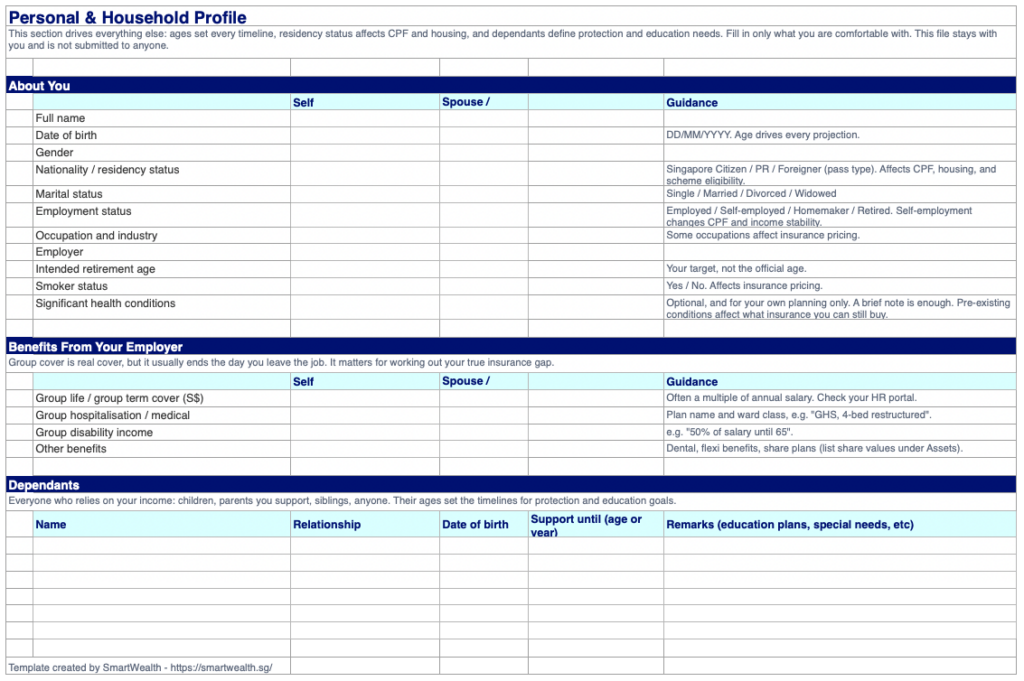
This section matters more than any other. Every timeline in financial planning starts from a date of birth. Every protection number starts from who depends on your income, and for how long.
It also captures your benefits from work: group life, group medical, group disability income. Group cover is real cover, but it usually ends the day you leave the job, so it changes how any insurance gap should be read.
3) Income and expenses
Monthly income for each of you (including gross salary and CPF contributions, not just take-home), your intended savings, your monthly expenses, and a section most budgets miss entirely: annual and irregular expenses.
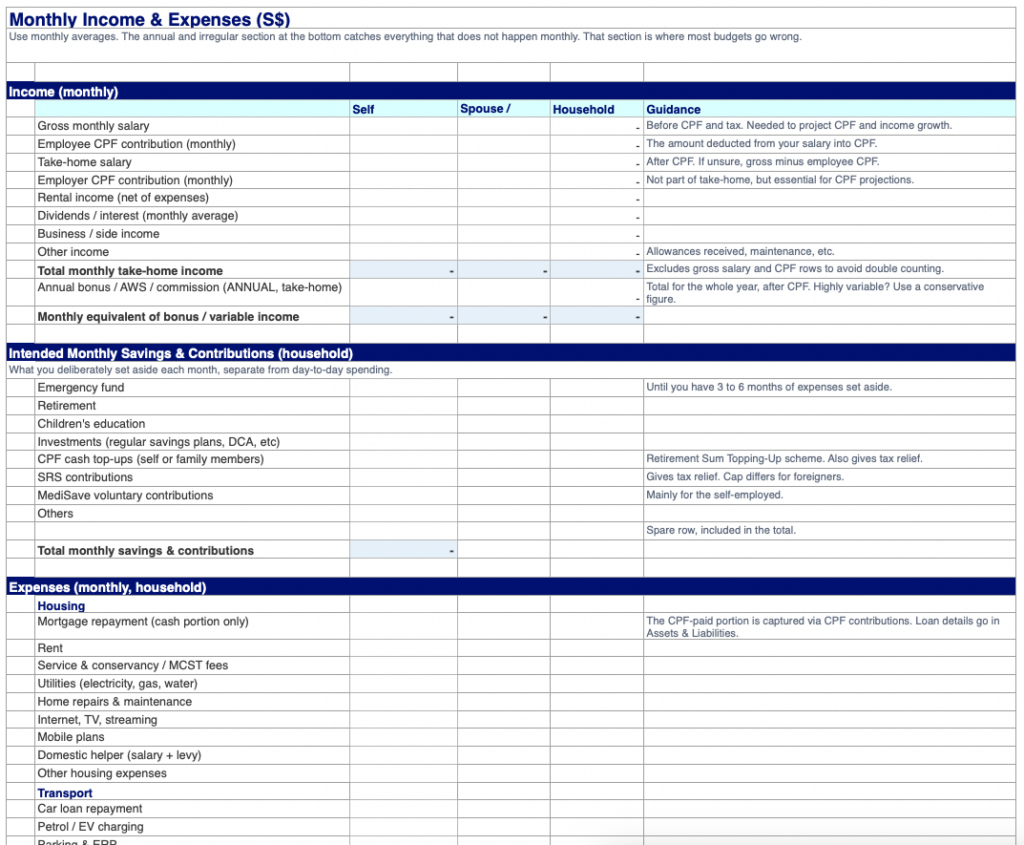
Holidays, festive spending, annual insurance premiums, road tax, parents’ one-off bills. These quietly add hundreds or thousands a month, and they’re the usual reason a budget doesn’t reconcile with reality.
The sheet works out where your take-home income goes, in the spirit of the 50/30/20 budget rule.
Why do expenses matter for safekeeping too? Because life around you goes on. If your family doesn’t know an insurance premium is due, the policy lapses. Even if it’s reinstated, waiting periods start again.
4) Assets and liabilities
Everything you own and owe, with the context that makes the numbers usable. Totalled up, this is your net worth, the one number that sums up where you stand.
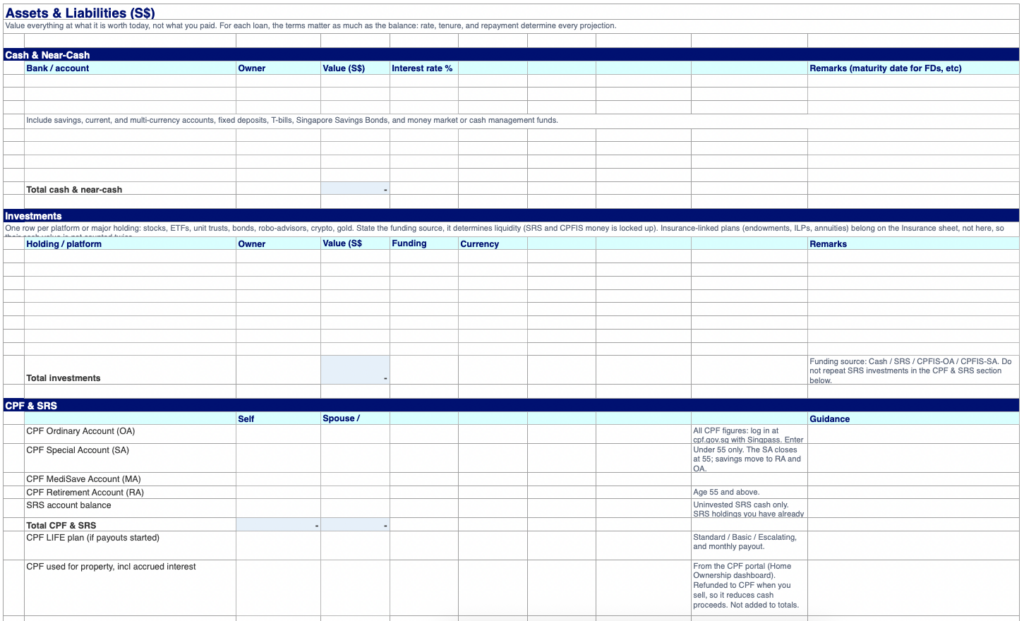
Whether or not you’ve made a will, a Schedule of Assets has to be submitted upon death. If you’ve never listed your holdings, your executor will have to write to every financial institution to ask. Certain assets, like cryptocurrency, may simply be lost.
FinSnap goes further than a list. For property, it records the remaining lease and the CPF you’ve used plus accrued interest, which determines the actual cash you’d receive on a sale. For each loan, it records the interest rate, monthly repayment, and remaining tenure. A $300,000 mortgage at 4.2% floating with 25 years left is a completely different planning problem from the same balance at 2.6% fixed with 8 years left.
CPF gets its own block, which reflects the closure of the Special Account for members aged 55 and above that took effect in January 2025.
QUICK CHECK
Can you answer these three questions?
1) If something happened to you tomorrow, how much would your family receive?
2) At 65, what monthly income will your savings and investments pay you?
3) If you never get round to a will, who inherits what, and in what proportion?
Most people manage one at best. Not because they're careless, but because nobody has shown them which order to tackle things in.
That order exists. Work through your finances in this sequence, from income and protection through to investments and estate planning.
5) Insurance policy summary
One row per policy, for both of you, across life and critical illness cover, hospitalisation plans, disability income, long-term care such as CareShield Life supplements, personal accident, default schemes like DPS and the Home Protection Scheme, and wealth accumulation plans.
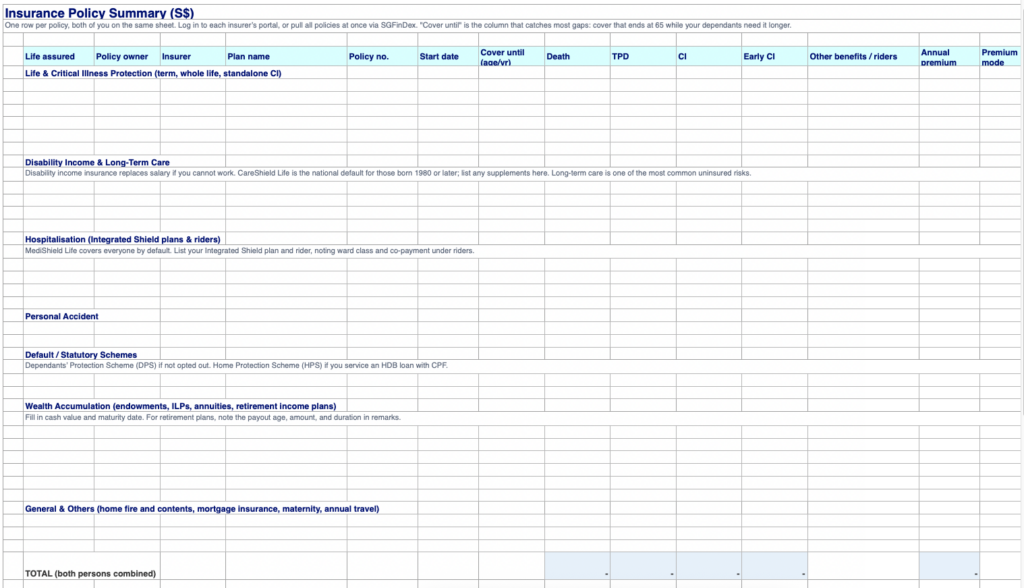
Many consumers don’t know what they’ve bought. A proper insurance policy summary helps at claim time, and it also reveals shortfalls. The “cover until” column is the one that catches most gaps: cover that ends at 65 while your dependants need it for longer.
If you’d like a quick sense-check of whether your cover is adequate, our life insurance calculator is a good place to start.
6) Goals and risk profile
Target retirement age and desired retirement income, education plans for each child, property plans, and other goals, each with a target year, an amount, and a priority. Plus a short risk profile for each of you.
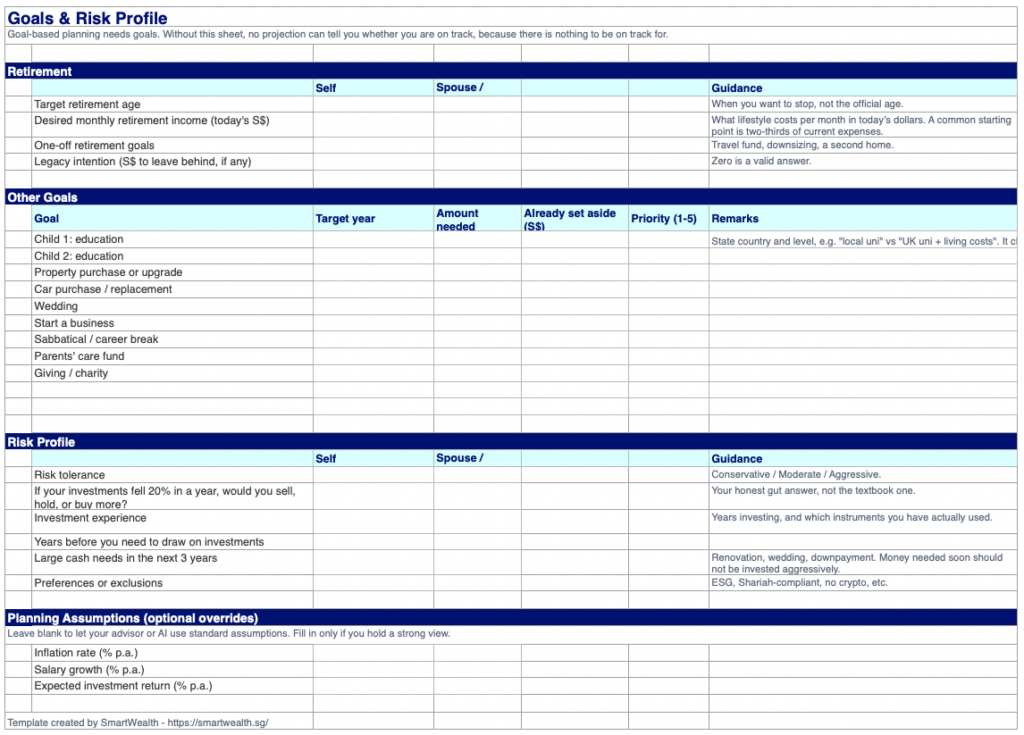
This section exists because goal-based planning is impossible without goals. A projection can only tell you whether you’re on track if there’s something to be on track for.
7) Estate and essential information
A pre-filled checklist of what’s in place and what isn’t: will, CPF nomination, LPA, trusts, guardianship for minor children, digital assets, document locations, key contacts, and more, each with a status column and a “where to find it” column.
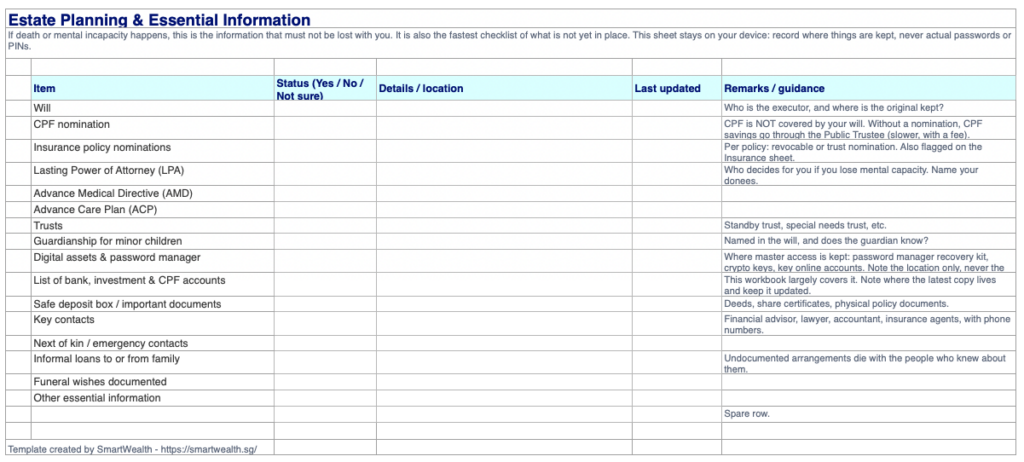
In this digital age, online accounts are the most overlooked item. One rule we’ve built into the template: record where your passwords are kept, never the passwords themselves.
Is Your Information Private?
Yes. FinSnap is a file, not a service. It lives in your own Google account or on your own device, and nothing you type in it is sent to us or anyone else.
Fill in only what you’re comfortable recording. A rough figure beats a blank, and a blank is always allowed.
If you later choose to share the completed file, with a family member, an advisor, or an AI tool, that’s entirely on your terms. The point of making it comprehensive is that when you do share it, whoever (or whatever) is helping you finally has the full picture.
How to Download and Use the Template
The FinSnap download link goes to a public Google Sheet created by us.
You have two options:
- Make a copy to your own Google account (File, then Make a copy)
- Download it as an Excel file and use it offline
I prefer the first, because it’s accessible from anywhere and easy to update. If you use Google Sheets, do check that your spreadsheet locale is set to Singapore so dates behave correctly.
Then set aside one unhurried evening. Most of the time goes into logging in to things: Singpass for CPF, your banks or SGFinDex for balances, insurer portals for policies. Once gathered, the file mostly maintains itself with a short review once or twice a year.
How Should Your Loved Ones Access It?
FinSnap isn’t a sure-fire system, and you could even use a note-taking app instead. The core idea is that the information should be usable and accessible when it’s needed.
How you share it depends on your comfort level. Some examples to get you thinking:
- Share the file directly with your executor or family members
- Print a copy and let your loved ones know where it’s kept
- Place a printed copy in a safe box at home, alongside your will and other documents
Anything kept digitally carries some risk of being accessed by unintended people, so make sure proper digital hygiene is in place.
What’s Next?
In the bigger picture, there are three areas to look at.
Firstly, financial planning ensures you have proper protection and wealth, for example through retirement planning, so that you have something to lean on and pass to the next generation. If you’d rather not piece it together alone, comprehensive financial planning covers protection, retirement, and estate in one structured review.
Secondly, advance care planning ensures things go smoothly if you’re ever unable to speak for yourself.
Lastly, planning your estate ensures that everything you have passes properly to your intended beneficiaries.
FinSnap ties it all together. One file, filled in honestly, that tracks your finances while you’re here, and holds the information your family will need if one day you can’t explain it yourself.
If you think this is a great idea, make use of it and share this article with your family and friends.
BEFORE YOU GO
Articles can tell you what generally makes sense. They can't see your policies, your CPF, or your plans.
FullCircle is our comprehensive financial planning session. A licensed consultant goes through what you have, shows you the gaps and overlaps, and tells you what to prioritise across protection, retirement, and estate planning.
It's complimentary, takes about 45 minutes, and if nothing needs changing, we'll say so.