

Somewhere at home, there’s a drawer or folder holding insurance policies bought over the past 10 or 15 years. Some came from different advisers, one or two from an ex-classmate who joined the industry. If you had to say, right now, how much you’re covered for if you fell seriously ill, could you?
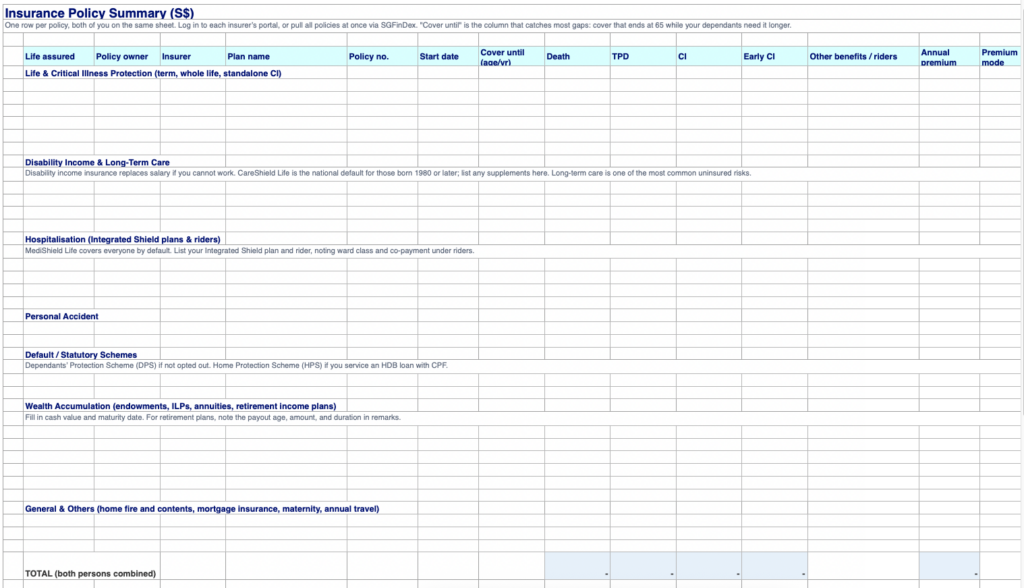
An insurance policy summary is the fix: a single table listing every policy you own, what each one pays and for which event, what it costs, and until when. One page, and your total cover finally becomes visible at a glance.
You don’t need to build the table yourself. FinSnap, our free financial snapshot template, includes a ready-made Insurance Policy Summary sheet alongside the rest of your financial picture. It’s a Google Sheet: make your own copy (or download it as an Excel file), and it’s yours to keep.
Key Takeaways
- An insurance policy summary is a one-page table listing every insurance policy you own (sometimes called an insurance portfolio summary).
- It records the insurer, policy number, benefits, sum assured, premiums, and key dates, so your total coverage sits in one place instead of five folders.
- Our free FinSnap Google Sheet includes an Insurance Policy Summary sheet with the fields already set up: no email required, and you can make your own copy or download it as a spreadsheet to keep.
SIDE NOTE
A policy bought years ago. Savings in three places. A will that's still on the to-do list.
None of it is wrong. It's just not a plan yet.
There's an order that turns the pieces into one system, and it doesn't require becoming a finance expert. Here's the order, in 7 steps, so you know what to sort out first.
Why Bother? 4 Problems a Policy Summary Solves
Most of us treat insurance as a buy-and-forget purchase. That works fine until one of these four problems shows up.
1) Policies your family never finds
A payout can only reach your family if they know the policy exists. As at 31 December 2024, $278 million in unclaimed monies was sitting with the Public Trustee’s Office, $184 million of it un-nominated CPF savings. Life insurance has its own version of the problem: payouts go unclaimed simply because nobody tells the insurer the policyholder has died. When the industry’s register of unclaimed proceeds launched in 2016 it was already holding more than 8,000 such payouts, and it has since been permanently withdrawn, so today there is no public list your family can search.
A one-page summary, kept where your family can find it, prevents all of this. It’s the cheapest piece of estate planning you’ll ever do.
2) Overinsuring without realising it
It’s easy to pay for more cover than you need when it’s spread across policies. Say you bought a whole life plan in your twenties, added a term policy when the mortgage came along, and both carry a critical illness rider. That can stack up to far more death or CI cover than you actually need, with premiums to match. These are lump-sum benefits, so unlike a medical bill they would each pay out, but you may still be funding cover well beyond your need while a real gap sits somewhere else. You only see it when every sum assured lines up in one table.
3) Gaps you can’t see policy by policy
The opposite problem is more common, and critical illness is where it bites hardest. The Life Insurance Association’s 2022 Protection Gap Study found economically active Singaporeans carry a mortality protection gap of 21%, but a critical illness protection gap of 74%, a $579 billion shortfall. Put plainly, most people are only about a quarter of the way to the CI cover they’d actually need. Plenty of people holding five or six policies are still underinsured here, because those policies are mostly endowments and savings plans rather than protection. If your summary shows little or no critical illness cover, that’s usually the first gap worth closing.
Each policy looks respectable on its own. Only the totals row tells the truth.
4) Claims are when being organised pays off
A claim usually arrives at the worst possible moment, after a diagnosis, an accident, or a death. A family that can immediately name the insurer, policy number, and servicing adviser files a claim in days. A family digging through drawers and guessing at logins takes months, and our look at life insurance claim statistics shows the sums at stake are far too large to leave to luck.
What an Insurance Policy Summary Should Record
Here is every field worth capturing, and why. This is exactly the structure FinSnap’s insurance sheet uses.
Identifying each policy
| Field | Why it matters |
|---|---|
| Policy type | Term life, whole life, endowment, IP, personal accident, disability income |
| Insurer | Whom your family calls |
| Plan name | Policies get renamed after mergers, the schedule name is the anchor |
| Policy number | The single detail that speeds up every claim |
| Policy owner and life assured | These differ more often than people think, especially for policies parents bought for you |
That last row catches many people out. A policy your parents bought on your life may still be owned by them, which changes who can make changes and who receives the money.
QUICK CHECK
Can you answer these three questions?
1) If something happened to you tomorrow, how much would your family receive?
2) At 65, what monthly income will your savings and investments pay you?
3) If you never get round to a will, who inherits what, and in what proportion?
Most people manage one at best. Not because they're careless, but because nobody has shown them which order to tackle things in.
That order exists. Work through your finances in this sequence, from income and protection through to investments and estate planning.
What each policy pays
Record the sum assured separately for each benefit: death, total and permanent disability (TPD), critical illness, early critical illness, hospitalisation, and disability income. One policy often carries several benefits through riders, so a single “coverage” number hides more than it reveals.
Then add a totals row per benefit. This is the entire point of the exercise: your total death cover across all policies, your total CI cover, and so on. Overlaps and gaps only become visible here.
What it costs, and until when
- Premium amount and frequency, converted to an annual figure so the total is honest
- Payment method, because GIRO quietly keeps paying for policies you’ve mentally filed away
- Premium end date, since some policies are paid up long before cover ends
- Cover end date, the date that matters most. A term policy expiring at 65 while your mortgage runs to 70 is a known gap with a known date.
The details families need at claim time
- Whether a beneficiary nomination has been made, and when it was last reviewed
- Your servicing adviser’s name and contact
- Where the physical policy or e-policy login sits
None of these affect what you pay or what you’re covered for. All of them decide how fast the money moves when it has to.
Can’t I Just Use My Insurer’s App?
They’re a good start, and not enough on their own.
Your insurer’s app shows you the policies you hold with that insurer, and if all your cover sits with one company, it’s a useful baseline. But several important things never appear in it:
- Employer group cover, which can be a sizeable slice of a household’s death and TPD benefit, though it usually isn’t portable and ends when the job does
- MINDEF/MHA group insurance, which covers a large share of Singaporean men and their families at very affordable rates
- The Dependants’ Protection Scheme, the CPF-linked term cover many members carry without remembering
- Rider-level detail, beneficiary nominations, adviser contacts, and where your documents are kept
Run several insurers and the blind spots multiply, one app at a time, and they all share one structural problem: your family would need your logins to see any of it. A summary in a single file is the one place everything sits together, openable by the people who’ll need it without any insurer logins.
How to Fill Yours In (One Unhurried Evening)
Set aside one evening. Here’s the quickest way through it:
- Gather the paperwork. For each policy, the policy schedule (the first few pages) carries almost every field: plan name, policy number, benefits, sum assured, premium, and dates.
- Fill the gaps digitally. Insurer apps cover policies whose paperwork has gone missing. For MediShield Life and CareShield Life, log in to your CPF account. For DPS, check with Great Eastern, the scheme’s insurer.
- Ask HR. Request a benefits summary for your employer group cover, and note that it ends when the job does.
- Start with the policies you’re least sure about. They’re the reason you’re doing this.
Can’t trace an old policy at all? Approach the insurer directly with your NRIC. Insurers can search their records even if you’ve lost every document, and mergers mean your policy may now sit with a different company than the one you bought from.
What Your Totals Are Telling You
Once the totals row is filled, compare it against the benchmarks in the Basic Financial Planning Guide, launched by MAS and MoneySense in 2023: cover of 9 times your annual income for death and TPD, and 4 times your annual income for critical illness, while spending at most 15% of income on protection premiums. Where a row falls short, our insurance planning guide sets out which gap to close first.
If your totals fall short, our life insurance calculator works out what your own numbers should be, based on your income, debts, and dependants. And where a gap is real, closing it is usually cheaper than expected: comparing term life insurance plans shows how much pure protection a modest premium buys, while whole life insurance suits those who want cover paired with cash value.
In my opinion, the summary’s real value is that it turns “I think I have enough insurance” into a number you can check. Whatever direction you take from there, remember that any new application is subject to underwriting and full health disclosure, and what suits your colleague may not suit you.
Keep It Where Your Family Can Find It
A perfect summary nobody can find fails at the only moment it matters.
Save the file somewhere your spouse or a trusted family member can reach, tell that one person where it lives, and mention it exists. That’s the entire system. Review it once a year or after any big life event, a marriage, a child, a new home, and it stays current with ten minutes of effort.
This habit sits naturally beside the rest of your estate planning: the summary tells your family what exists, while your will and nominations decide who receives it. Each is incomplete without the other.
You’ve Just Described One Tab of the Full Picture
Everything on this page maps to a single sheet in FinSnap, our free financial snapshot template. The Insurance Policy Summary sheet has the fields above already built, with the totals done for you. The remaining sheets cover what a policy list alone can’t see: your income and expenses, assets and liabilities, goals and risk profile, and estate information.
It’s a template you fill in yourself, not a service. Your copy is yours, and nothing you enter is sent to us.
If you’d rather have a professional walk through the finished picture with you, spotting the overlaps and gaps and putting your numbers in context, our comprehensive financial planning session does exactly that, at no cost to you.
BEFORE YOU GO
Articles can tell you what generally makes sense. They can't see your policies, your CPF, or your plans.
FullCircle is our comprehensive financial planning session. A licensed consultant goes through what you have, shows you the gaps and overlaps, and tells you what to prioritise across protection, retirement, and estate planning.
It's complimentary, takes about 45 minutes, and if nothing needs changing, we'll say so.