

How long can you expect to live in Singapore? Longer than almost anywhere else on Earth, and longer than ever before.
That’s good news, but it changes your financial planning maths: more years to fund, more years of healthcare, and a real chance of living past 90.
In this article, we look at the latest official data on life expectancy in Singapore, how the country compares globally, where the numbers are heading, and what all of it means for you and your loved ones.
Summary of Key Findings
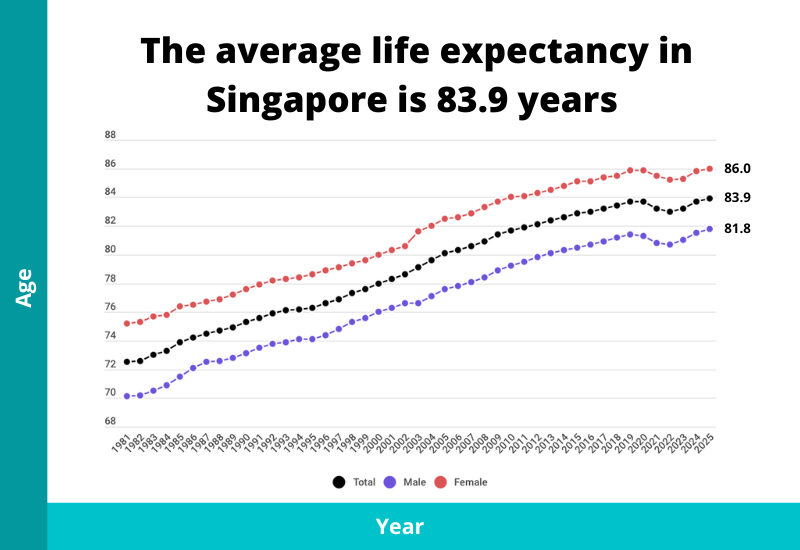
- The average life expectancy in Singapore reached 83.9 years in 2025, the highest ever recorded
- Men can expect to live 81.8 years on average, and women 86.0 years
- Residents aged 65 in 2025 can expect to live another 21.6 years on average, to age 86.6
- 47.6% of newborn boys and 64.3% of newborn girls are expected to still be alive at age 85
- Singapore’s healthy life expectancy was 73.6 years in 2021 (WHO), meaning close to 10 years are typically spent in poor health
- Singapore ranks 12th globally on the UN-based 2026 rankings, well above the world average of 73.8 years
SIDE NOTE
A policy bought years ago. Savings in three places. A will that's still on the to-do list.
None of it is wrong. It's just not a plan yet.
There's an order that turns the pieces into one system, and it doesn't require becoming a finance expert. Here's the order, in 7 steps, so you know what to sort out first.
The Source of Our Data
Various studies measure life expectancy with different methods, so we rely on national statistics for consistency and accuracy.
Our primary source is the Singapore Department of Statistics, which has published life expectancy data for Singapore residents since 1957. The latest release, the Complete Life Tables for Singapore Resident Population 2024-2025, was published on 3 June 2026.
For global comparisons, we use UN-based estimates, and for healthy life expectancy, data from the World Health Organization. We flag these clearly where they appear.
This page is updated regularly as new official data is released.
The Definition of Life Expectancy
Life expectancy is the average number of years a person is expected to live. It is usually measured in two ways:
- At birth: the number of years a newborn is expected to live. This is what we mean by “life expectancy” in this article unless stated otherwise.
- At age 65: the number of additional years a person aged 65 is expected to live.
Two caveats are worth knowing before you read the numbers.
First, the published figure assumes today’s death rates stay frozen for an entire lifetime. SingStat itself notes the measure does not account for future changes in mortality. Since death rates in Singapore have fallen decade after decade, a child born today will most likely live longer than the headline figure suggests.
Second, life expectancy is an average. Roughly half of the population will live beyond it. If you plan your retirement to end exactly at the average, you have close to a coin-flip chance of outliving your money.
8 Statistics on Life Expectancy in Singapore (2026)
Here are the most important facts and figures from the latest data.
1) The average life expectancy in Singapore is 83.9 years, the highest ever
Singapore residents’ life expectancy at birth reached 83.9 years in 2025, based on the Complete Life Tables 2024-2025. That finally surpasses the pre-pandemic peak of 83.7 years set in 2019.
| Year | Life Expectancy at Birth (Years) |
|---|---|
| 2025 | 83.9 |
| 2024 | 83.7 |
| 2023 | 83.2 |
| 2022 | 83.0 |
| 2021 | 83.2 |
| 2020 | 83.7 |
| 2019 | 83.7 |
| 2018 | 83.4 |
| 2017 | 83.2 |
| 2016 | 83.0 |
| 2015 | 82.9 |
| 2014 | 82.6 |
| 2013 | 82.4 |
| 2012 | 82.1 |
| 2011 | 81.9 |
| 2010 | 81.7 |
| 2005 | 80.1 |
| 2000 | 78.0 |
| 1990 | 75.3 |
| 1980 | 72.1 |
Life expectancy has risen from 72.1 years in 1980 to 83.9 years in 2025. Put another way, Singaporeans born today can expect almost 12 more years of life than those born 45 years ago.
The climb was interrupted only once. Life expectancy dipped during the COVID-19 pandemic, falling to 83.0 years in 2022, before recovering in 2023 and setting new records in 2024 and 2025. SingStat notes the 2020 to 2023 figures were affected by pandemic-era mortality and may understate how long people will actually live now that death rates have normalised.
2) Men in Singapore can expect to live 81.8 years on average
Male life expectancy at birth was 81.8 years in 2025, up from 81.5 years in 2024 and 80.5 years a decade ago.
| Year | Male Life Expectancy at Birth (Years) |
|---|---|
| 2025 | 81.8 |
| 2024 | 81.5 |
| 2023 | 81.0 |
| 2022 | 80.7 |
| 2021 | 80.8 |
| 2020 | 81.3 |
| 2019 | 81.4 |
| 2018 | 81.2 |
| 2017 | 80.9 |
| 2016 | 80.7 |
| 2015 | 80.5 |
Looking further back, men born in 1980 had a life expectancy of just 69.8 years. Today’s figure represents a gain of 12 years over 45 years.
3) Women in Singapore can expect to live 86.0 years on average
Female life expectancy at birth was 86.0 years in 2025, up from 85.8 years in 2024 and 85.1 years in 2015.
| Year | Female Life Expectancy at Birth (Years) |
|---|---|
| 2025 | 86.0 |
| 2024 | 85.8 |
| 2023 | 85.3 |
| 2022 | 85.2 |
| 2021 | 85.5 |
| 2020 | 85.9 |
| 2019 | 85.9 |
| 2018 | 85.5 |
| 2017 | 85.4 |
| 2016 | 85.1 |
| 2015 | 85.1 |
Women continue to outlive men by around four years, a gap that has stayed remarkably stable over the decades. In 1980, the gap was 4.9 years (74.7 versus 69.8). In 2025, it is 4.2 years.
That gap matters for planning. In many couples, the wife will spend several years managing the household finances alone, which is one reason both partners should be involved in planning decisions from the start.
4) At 65, Singapore residents can expect to live another 21.6 years
Residents aged 65 in 2025 can expect to live another 21.6 years on average, to age 86.6. Men at 65 can expect to reach 84.9, and women 88.1.
This is arguably the more useful number for retirement planning. Life expectancy at birth includes deaths at every age, but if you have already reached 65, those risks are behind you, so your expected lifespan is longer than the headline figure.
| Year | At 65: Total (Years) | Males (Years) | Females (Years) |
|---|---|---|---|
| 2025 | 21.6 | 19.9 | 23.1 |
| 2024 | 21.4 | 19.7 | 22.9 |
| 2023 | 20.9 | 19.2 | 22.4 |
| 2022 | 20.7 | 19.0 | 22.3 |
| 2021 | 20.9 | 19.1 | 22.6 |
| 2020 | 21.3 | 19.5 | 23.0 |
| 2019 | 21.4 | 19.5 | 23.0 |
| 2018 | 21.2 | 19.4 | 22.7 |
| 2017 | 21.0 | 19.2 | 22.6 |
| 2016 | 20.8 | 19.0 | 22.4 |
| 2015 | 20.8 | 18.9 | 22.3 |
For context, a 65-year-old in 1980 could expect just 14 more years. Today’s 65-year-olds have gained over seven years of remaining life in the span of two generations.
5) Almost half of newborn boys and two-thirds of girls are expected to reach 85
The 2024-2025 life tables also show survival rates, and they make longevity risk concrete.
Based on the latest release, 90.3% of newborn boys are expected to still be alive at 65, and 47.6% at 85. For newborn girls, the figures are 94.4% and 64.3%.
| Expected to be alive at | Boys (2015) | Boys (2025) | Girls (2015) | Girls (2025) |
|---|---|---|---|---|
| Age 65 | 89.0% | 90.3% | 93.6% | 94.4% |
| Age 85 | 42.3% | 47.6% | 59.0% | 64.3% |
Living to 85 or beyond is no longer the exception. For women, it is now the most likely outcome. Any retirement plan that assumes the money only needs to last to 80 is planning for a scenario that most Singaporeans will outlive.
QUICK CHECK
Can you answer these three questions?
1) If something happened to you tomorrow, how much would your family receive?
2) At 65, what monthly income will your savings and investments pay you?
3) If you never get round to a will, who inherits what, and in what proportion?
Most people manage one at best. Not because they're careless, but because nobody has shown them which order to tackle things in.
That order exists. Work through your finances in this sequence, from income and protection through to investments and estate planning.
6) Healthy life expectancy is around 74 years
Living longer is only half the story. The other half is how many of those years are spent in good health.
The two measures answer different questions. Life expectancy is the total number of years you’re expected to live. Healthy life expectancy (or HALE) counts only the years you’re expected to spend in good health, before ongoing illness or disability sets in. The gap between them is the number of years typically lived in poor health.
The World Health Organization estimates Singapore’s healthy life expectancy at birth was 73.6 years in 2021, against an overall life expectancy of 83.2 years that year. That is a gap of close to 10 years typically spent living with illness or disability, usually at the end of life.
The gap has direct financial consequences. Those final years are when healthcare costs concentrate: chronic disease management, hospitalisation, and long-term care. Adequate hospitalisation cover, such as an Integrated Shield Plan, and a healthcare buffer in your retirement sum help ensure those years don’t drain the savings meant for living.
7) Singapore ranks 12th in the world for life expectancy
On the UN-based 2026 rankings compiled by Worldometers, Singapore places 12th globally with a life expectancy of 84.13 years, well above the world average of 73.8 years.
Here is the top 10, plus the two places down to Singapore at 12th:
| Rank | Country / Territory | Years |
|---|---|---|
| 1 | Monaco | 86.73 |
| 2 | San Marino | 86.03 |
| 3 | Hong Kong | 85.90 |
| 4 | Japan | 85.15 |
| 5 | South Korea | 84.64 |
| 6 | Saint Barthelemy | 84.63 |
| 7 | Andorra | 84.46 |
| 8 | French Polynesia | 84.44 |
| 9 | Switzerland | 84.37 |
| 10 | Australia | 84.34 |
| 11 | Italy | 84.18 |
| 12 | Singapore | 84.13 |
You may notice the UN figure (84.13 years) differs slightly from SingStat’s (83.9 years). That’s normal: the UN uses its own estimation methods and reference periods, so international rankings never match national statistics exactly. Rankings also shuffle from year to year as small differences separate the top countries.
Whichever source you use, the conclusion is the same. Singapore is among the longest-lived populations in the world, ahead of most developed countries and more than 10 years above the global average.
8) Life expectancy is projected to keep rising towards 2040
A 2018 study published in The Lancet projected Singapore’s life expectancy would reach 85.4 years by 2040, among the highest in the world.
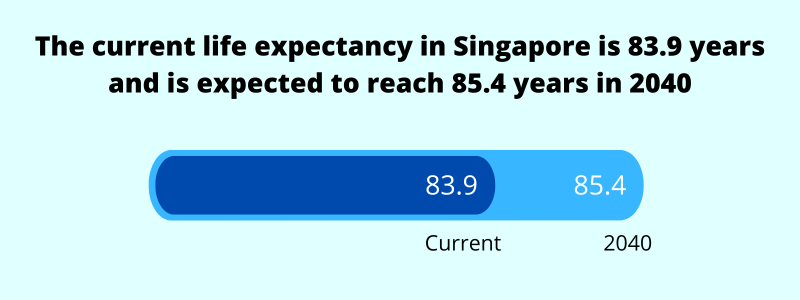
The trajectory since then suggests the projection remains on track. UN-based estimates already put Singapore at 84.4 years in 2026, and the national figure has set new records for two years running.
As with any projection, this may or may not materialise. Historically, the trend has been upward for nearly seven decades, but past data doesn’t guarantee future outcomes. What we can say is that every year of data so far has pointed the same way: longer lives, and more years to plan for.
Why Is Singapore’s Life Expectancy So High?
Singaporeans are living longer, but why?
Doctors at Singapore General Hospital attribute this to the early prevention and detection of chronic diseases like high blood pressure, diabetes, and heart disease. Catching these conditions early allows them to be managed through long-term medication, regular follow-ups, and close monitoring.
Singapore’s healthcare system also plays a part. Strong coordination between doctors, patients, and caregivers means people receive treatment when they need it, and national screening programmes catch problems before they become serious.
Medical advances have helped too. Better diagnostic tools and newer treatments, including targeted cancer therapies, have improved survival for diseases that were once fatal.
The result shows up in the mortality data: at any given age, a Singaporean today is far less likely to die than someone the same age a generation ago. Our guide to death statistics in Singapore covers those numbers in detail.
The Financial Impacts of a Longer Life Expectancy
Is living longer always a blessing? It depends on how well you’ve prepared for it.
If you remain healthy and financially comfortable, a longer life is a gift. But each extra year also has to be paid for, and some of those years will come with health challenges. Three impacts stand out.
1) More years spent in ill health
As the healthy life expectancy figures show, close to 10 of the average Singaporean’s years are spent in poor health, and that stretch typically comes at the end of life, when medical bills are highest.
The practical response is twofold. Keep your hospitalisation cover adequate as you age, and build a dedicated healthcare buffer into your retirement planning rather than assuming your general savings will stretch to cover it. Our guide to planning your insurance covers how the hospitalisation layer works and what sits on top of it.
2) Lower premiums for life insurance
Here’s some good news for once: rising life expectancy has made life insurance more affordable.
As people become less likely to die during the coverage period, insurers price policies lower. A $1 million term life insurance policy costs far less today than an equivalent policy did a decade ago.
If you bought your cover years ago, it may be worth comparing it against today’s pricing. Do proceed carefully if you have pre-existing conditions though, since a new application means fresh underwriting and health disclosure.
3) A longer retirement to fund
This is the impact with the biggest dollar signs attached.
Say you retire at 65. The average resident that age will live another 21.6 years, so your savings need to last to roughly 87 on average. But remember that averages are midpoints: nearly two-thirds of women and almost half of men are expected to reach 85, and many will go well past 90.
Planning to age 90 or beyond is no longer conservative. It’s realistic.
Every extra year of retirement means another year of living expenses, healthcare, and inflation. The earlier you start, the more of that burden compound growth carries for you. Our retirement planning guide walks through how to size that number for your own situation, and our retirement calculator gives you a quick first estimate.
Conclusion
Singapore’s life expectancy is at a record high, and the trend points upward. On the whole, that is something to celebrate.
But the data carries a clear planning message. You will probably live longer than you think, close to 10 of those years may come with health problems, and your retirement savings may need to last 25 years or more.
So plan for the long life the data says you’re likely to get:
- Review your hospitalisation and critical illness cover so the unhealthy years don’t derail the healthy ones
- Take advantage of lower term insurance premiums to secure affordable protection
- Start (or stress-test) your retirement plan against living to 90 and beyond
If you’d like a professional to look at the whole picture with you, consider a comprehensive financial planning consultation.
BEFORE YOU GO
Articles can tell you what generally makes sense. They can't see your policies, your CPF, or your plans.
FullCircle is our comprehensive financial planning session. A licensed consultant goes through what you have, shows you the gaps and overlaps, and tells you what to prioritise across protection, retirement, and estate planning.
It's complimentary, takes about 45 minutes, and if nothing needs changing, we'll say so.