


Most financial planning is about one question: will I have enough?
At some point, if things go well, a second question turns up. What happens to the money I don’t spend?
Maybe you got there on your own, thinking about your children and what you’d like to leave them. Or maybe a banker or an adviser has shown you a “legacy plan”, and you want to know whether it’s any good before you sign anything.
Either way, this guide is for you. It goes through the main types of legacy insurance plans in Singapore in one place.
Key Takeaways
- Legacy planning insurance is life insurance bought to grow and pass on wealth, not to replace your income if you die early.
- There are four main plan types in Singapore: term insurance till 99, legacy whole life, universal life (including indexed universal life, or IUL), and lifetime or legacy income plans.
- Singapore has no inheritance tax. Estate duty was scrapped for deaths on and after 15 February 2008, so people buy these plans to grow the money, to give the family quick cash, and to split things fairly between heirs, not to save tax.
- A life insurance payout with a valid nomination skips the probate queue and usually reaches your family within weeks, while money held only in your name can take months to unlock.
- IUL is now the legacy plan wealthy buyers choose most, and some insurers set the minimum cover at US$250,000, which brings these plans within reach of ordinary well-off families.
SIDE NOTE
A policy bought years ago. Savings in three places. A will that's still on the to-do list.
None of it is wrong. It's just not a plan yet.
There's an order that turns the pieces into one system, and it doesn't require becoming a finance expert. Here's the order, in 7 steps, so you know what to sort out first.
What Is Legacy Planning Insurance (And What It Is Not)?
Legacy planning insurance is life insurance you buy to grow and pass on the wealth you leave behind, rather than to replace your income if you die early.
That difference matters more than it sounds.
The insurance most of us buy first, like term life cover, is there to protect your family if you lose your income during your working years. Legacy planning insurance works from the other end. You already have the money. The plan’s job is to turn part of it into a larger, guaranteed sum for the people you leave it to, and to make sure that money reaches them quickly and in the shares you wanted.
And no, this isn’t only for the very rich. These plans used to be sold almost only to wealthy clients, but the entry price has come down a lot in recent years. We’ll get to the numbers later, but some plans now start at cover of US$250,000, which puts them within reach of many comfortable, well-off families in Singapore.
Legacy planning vs estate planning: which do you need first?
Estate planning comes first, and the two aren’t the same thing.
Estate planning is the legal side: your will, your CPF and insurance nominations, your Lasting Power of Attorney, and any trusts. It decides who gets what, and who can act for you if you can’t. We cover it in full in our guide to estate planning in Singapore, and you can read more on the Lasting Power of Attorney separately.
Legacy planning insurance is the money side. It decides how much there is to hand out, and in what form your loved ones receive it.
In practice, you’ll want both. A well-drafted will is little use if there’s not much left to share, and a large estate causes problems if there are no clear instructions on who gets what.
Is There Inheritance Tax in Singapore? (So Why Do These Plans Exist?)
No. Singapore scrapped estate duty for deaths on and after 15 February 2008, and life insurance payouts to your beneficiaries aren’t taxed.
People often use this as a reason to skip legacy insurance. If there’s no tax to avoid, they ask, why bother?
It’s a fair question, and it deserves a straight answer. In Singapore, these plans aren’t about tax at all. They solve four other problems.
They grow the money. A legacy plan turns a fixed sum into a larger guaranteed one. Set aside $500,000 today and, depending on your age and health, the payout your family receives can be several times that. No other type of asset gives you a guaranteed uplift that pays out at exactly the moment it’s needed.
They give your family cash while the rest is frozen. When you die, bank accounts in your sole name are frozen, and your property can’t be sold until the courts grant probate (the legal go-ahead to deal with what you’ve left behind). Your family’s bills don’t pause while that happens. A nominated insurance payout lands outside this process, so your loved ones have money to live on while the rest of the estate is sorted out. Dying without a will makes the wait even longer.
They let you treat your children fairly. If most of your wealth sits in one property or one business, insurance creates the cash that lets you split things evenly without anyone having to sell. We cover this later in the guide.
They keep things certain and private. A nominated policy pays the people you named, in the shares you chose, and the payout doesn’t show up in the public probate record.
There’s a fifth benefit few people know about. If you make a trust nomination under section 49L of the Insurance Act, the policy money is held on trust for the people you named and is generally safe from your creditors. For business owners who’ve signed personal guarantees, that protection can matter as much as the payout itself.
Does a life insurance payout go through probate?
No. A life insurance payout with a valid nomination is paid straight to the people you named and doesn’t form part of the estate that goes through probate.
The table below shows how wide the gap in waiting time can be.
| What your family can access | How they receive it | Typical waiting point |
|---|---|---|
| Life insurance payout (nominated) | Claim submitted to the insurer with the death certificate | Usually weeks after the claim is submitted |
| CPF savings (nominated) | CPF Board contacts the people you named directly | Within 10 working days of being told about the death, and nominees who qualify are paid automatically |
| Joint bank account | Passes to the surviving holder, who generally keeps access | Usually no wait, once the bank has been told of the death |
| Everything else: sole accounts, property, investments | Grant of Probate or Letters of Administration | The application alone is usually filed within six months of death, and banks release money only after the grant is issued |
Sources: Singapore Courts and CPF Board, as of 2026. Actual timelines vary by case, and contested or complicated estates take longer.
The pattern is simple. Anything held only in your name has to wait for the courts. A nominated policy doesn’t.
The Best Ways to Leave an Inheritance to Your Children
Before any talk of products, it’s worth asking the plain question: what’s actually the best way to leave money to your children?
For most Singaporean families, the choices are property, investments, and insurance. Each behaves very differently on the day it matters.
Property feels the most solid, and it’s the asset most parents want to pass on. But you can’t split it easily, it’s slow to transfer, and it can force hard choices on your children over who keeps it, who sells, and who buys the others out. Our guide to property inheritance in Singapore walks through what that involves.
Investments like shares and unit trusts grow well over long periods, and nothing here argues against holding them. But their value on the day you die is whatever the market says it is, and they still go through probate.
Insurance is the only one of the three that pays a guaranteed sum you can divide right away, outside probate, straight to the people you named. The trade-offs are real. The money is locked away for the long term, and the growth is likely to be lower than shares over several decades.
So the honest answer isn’t one or the other. It’s a mix. Insurance earns its place as the certain, ready-cash layer of an inheritance, sitting alongside assets that grow faster but take longer to arrive.
As for how much to leave, there’s no magic figure, and we’d be wary of anyone who names one. For a sense of scale, the average household net worth in Singapore was $1.755 million as at 2023. The right number for you depends on your own retirement needs first.
The rest of this guide maps out the actual products, so you can see which tool fits which goal.
The Two Ways Insurance Builds a Legacy
Every legacy insurance plan in Singapore, whatever the brochure calls it, does one of two jobs. It either pays out once when you die, or it pays you an income while you live and leaves a benefit behind afterwards.
| Plan type | When it pays | What it does |
|---|---|---|
| Term insurance till 99 | Pays at death | Pure cover to age 99, no cash value. The simplest way to grow a sum |
| Legacy whole life | Pays at death | Lifetime cover plus growing cash value. The classic large policy |
| Universal life (traditional and indexed) | Pays at death | Flexible lifetime cover with an investment engine inside |
| Lifetime and legacy income plans | Pays while you live | Lifetime monthly income plus a payout at death, passable to the next generation. The old “3G” plans |
How you pay for the plan, whether in one lump sum, over a set number of years, or with a bank loan, is a separate decision that cuts across all four types. We cover paying by loan under strategies further down.
Term Insurance Till 99: The Simplest Way to Grow a Sum
Term insurance till 99 is what it sounds like: pure life cover that runs to age 99, with no savings or investment part attached.
Regular term insurance usually ends at 65 or 70, once your income-protection years are over. If you outlive it, and most people do, the cover simply stops. Stretching the term to 99 changes what the plan is for. Given how long Singaporeans live these days, a policy that covers you to 99 is likely to pay out. What started as protection becomes an almost certain legacy.

Because there’s no savings or investment part, your premiums pay for the death benefit rather than building up cash value. That makes term-to-99 the most affordable guaranteed way to grow a sum among the plans in this guide.
Here’s a simple example, using round numbers for clarity rather than a real quote. Say a 45-year-old takes $1 million of cover to age 99 at $8,000 a year. If he dies at 85, his family receives $1 million after 40 years of premiums adding up to $320,000. Even in the slowest case, dying at 99 after 54 years of premiums, the total paid comes to $432,000, still less than half the payout. That gap isn’t a trick. It reflects the odds of when someone dies, and the amount is fixed in the contract from day one.
It’s worth knowing that the industry itself is split on this plan type. Some advisers say term can’t really serve a legacy purpose, because a very long-lived client could outlive the cover at 99 and leave nothing. Others say the price gap is so wide that the small remaining risk is worth taking. There’s also a middle option: some plans guarantee they’ll pay the sum assured once you reach 100, which closes off the outliving risk, though you’ll pay a higher premium for it.
Legacy Whole Life: The Large-Sum and Single-Premium Route
You may remember this type of plan as “single premium whole life” or “jumbo” insurance. The plans still exist, but the label has changed.
Today’s version is a participating whole life plan built for passing on wealth: a large sum assured (the amount of cover), lifetime protection, and a cash value that grows through bonuses from the insurer’s pooled investment fund, known as the participating fund. Several insurers offer them, some in Singapore dollars, others in US dollars.
The bigger change is that paying a “single premium” is now just one way to fund the plan, not a separate type of plan on its own. The same legacy whole life plan can usually be paid for in one lump sum, or with premiums spread over a set number of years.
The main draw here is a high starting payout: the death benefit begins as a large multiple of what you put in, while the policy still builds up some cash value over time.
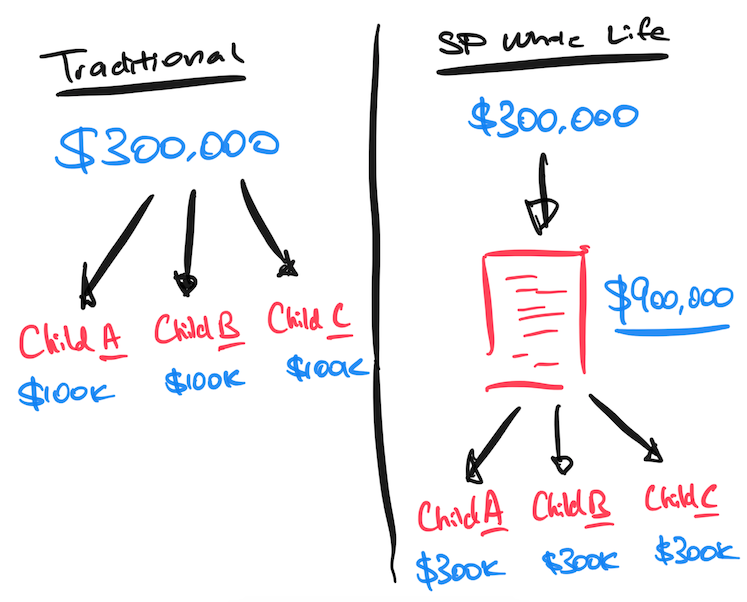
A quick word on the ordinary whole life insurance most Singaporeans already know, the kind bought younger for protection with premiums paid over 20 or 25 years. It can absolutely play a legacy role for well-off families, and if that’s your budget it’s usually the more sensible starting point. We keep a separate comparison of whole life insurance plans in Singapore for exactly that choice.
Whole life on a child
Everything so far has assumed a policy on your own life. Here’s a less obvious version almost nobody writes about: buying a whole life policy with your child as the person covered.
There’s real sense in it. Start a policy on a healthy five-year-old and you lock in their cover for life, before any health problems can show up and make cover harder or pricier to get later. The premiums are low because the child is young, and the cash value gets 50 years or more to grow before anyone needs it.
Here’s how it works. You own the policy and pay the premiums, and your child is the one covered. While they’re young, the policy is yours to control. When they are older, you can sign it over to them, so they end up with a policy that’s already funded and growing, which they would struggle to set up as cheaply on their own.
In that case you’re not really leaving a payout behind. You’re leaving them a policy that’s been growing for decades.
Universal Life Insurance: What Happened to the Old Standard?
Traditional universal life was the standard legacy plan for wealthy families in Singapore for two decades, but buyers have largely moved on to its indexed version, IUL, which we cover in the next section.
If you were shown a legacy plan before around 2022, it was probably a traditional universal life (UL) policy. It pairs lifetime cover with a cash value that earns a return the insurer declares each year (the crediting rate), which has often sat at around 2% a year on Singapore policies. There’s a guaranteed minimum the rate can’t drop below, but that floor is set by the insurer. The policies are usually priced in US dollars. Premiums are large, often paid as a single lump sum, and MoneySense’s guide to universal life notes that advisers may suggest paying for them with a bank loan, known as premium financing.
What goes on inside the plan deserves more attention than it usually gets. Part of your premium is eaten up by charges from the start, so the cash value on day one is usually well below what you paid in. Charges for the insurance itself are taken out throughout and rise as you age. If the interest credited can’t keep up with those rising charges, the cash value shrinks, and in a bad case the policy can lapse late in life, exactly when it was meant to pay out. The risk is greater still if the plan was paid for with a bank loan (premium financing): a shrinking cash value can prompt the bank to ask for a top-up, and if interest rates rise the loan costs more at the same time, so the policy can lapse sooner than one paid for in cash.
QUICK CHECK
Can you answer these three questions?
1) If something happened to you tomorrow, how much would your family receive?
2) At 65, what monthly income will your savings and investments pay you?
3) If you never get round to a will, who inherits what, and in what proportion?
Most people manage one at best. Not because they're careless, but because nobody has shown them which order to tackle things in.
That order exists. Work through your finances in this sequence, from income and protection through to investments and estate planning.
Indexed Universal Life (IUL): The Plan Taking Over the Legacy Market
IUL grew out of this plan, replacing the flat crediting rate with a return linked to the market. If you’ve been shown a legacy plan recently, there’s a good chance it was an IUL. The numbers behind that impression tell the story.
| The IUL shift in Singapore | |
|---|---|
| Major insurers that launched or upgraded IUL products within 12 months | More than five |
| Largest single policy reported | US$300 million, believed to be the largest in the region |
| Policies above US$50 million issued by one insurer in a year | 25 |
| Minimum cover at some insurers | US$1 million to US$2 million |
| Minimum cover at others | From US$250,000 |
Source: The Business Times, February 2026.
The last row is the quieter story. A US$250,000 minimum brings a product once reserved for the wealthy within reach of ordinary well-off families, and that shift has had far less attention than the record-breaking policies.
How an IUL actually works: caps, floors and participation rates
An IUL splits your premium between two accounts, and you choose the mix.
The fixed account works like traditional UL: a set return the insurer declares, currently around 2% a year, sometimes with a higher guaranteed rate in the first year or first few years. Put everything here and you’ve basically bought a traditional UL.
The index account is the new part. Its return is linked to a market index, most often the S&P 500, but with two twists. A floor of 0% means a falling market credits you nothing rather than a loss. In return, your upside is limited, either by a cap (say the index gains 12% but your cap is 10%, so you get 10%) or by a participation rate (at 80% participation, a 10% index gain gives you 8%).
The downsides your illustration may not show
Every IUL illustration shows attractive projected figures. Here’s what deserves just as much attention.
The return isn’t guaranteed beyond the floor and the fixed account’s minimum. The insurer can lower the caps and participation rates after you’ve bought. Most policies are priced in US dollars, so your family’s payout carries currency risk against the Singapore dollar. And if the plan is paid for with borrowed money, a weak market plus higher interest rates can force top-ups or, at worst, a lapse.
None of this makes IUL a bad product. It makes it one to buy with your eyes open, at the right age, for the right job.
Lifetime and Legacy Income Plans (Formerly Called 3G Plans)
Everything above pays out once, when someone dies. This type is different: it pays you an income while you’re alive, and what’s left carries on to the next generation.
These were sold a few years ago as “3G plans”, short for three generations. The name has faded, but the structure has grown up. Today’s versions are participating whole life income plans, paid for with a single or limited premium, that pay a lifetime monthly income after a short build-up period, with policy terms usually written to age 100.
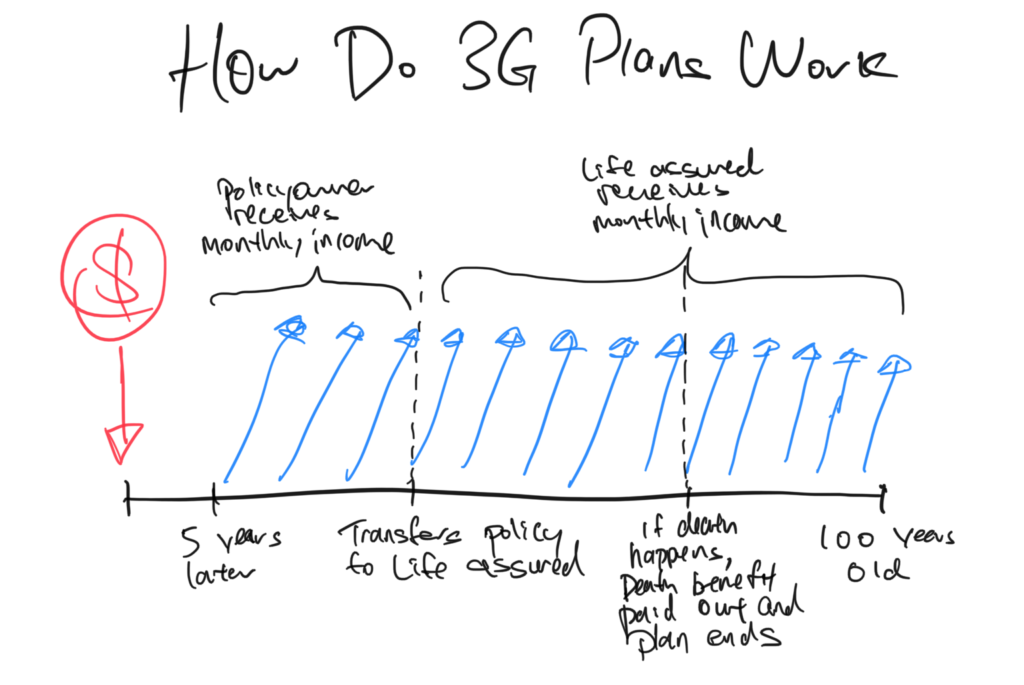
The way they pass down the generations is cleaner than it used to be. Most current plans let you formally change the person covered: you can start the policy on your own life, then switch the cover to your child part way through. The income keeps going, the cover keeps going, and when your child eventually dies, the payout goes to your grandchildren. One policy, three generations, without the ownership workarounds the older plans needed.
Two features carried over from the old generation are still worth checking. The income splits into a guaranteed portion and a non-guaranteed bonus that depends on the participating fund, and the balance between the two varies a lot between plans. And because these plans carry little insurance risk, many are sold with light or no health checks (simplified or guaranteed acceptance), which makes them one of the few legacy options open to buyers whose health rules out the plans above.
A newer development worth watching is the index-linked income plan, which borrows the IUL’s return mechanics for the everyday income market.
One trade-off is built in. These plans reward patience and punish early exits: surrender in the first few years and you may get back less than you put in. They suit money you’re confident you won’t need back, which is true of this whole type. If your priority is income for your own retirement rather than for your descendants, a retirement annuity plan is usually the better fit, and the wider trade-offs belong in your retirement planning picture.
How the Wealthy Use These Plans: Four Strategies
The products above are tools. What follows is how they’re actually used, and none of these needs extreme wealth, only wealth that sits in large assets that are hard to split.
Estate equalisation: treating your children fairly
This is the most common reason larger legacy policies are bought in Singapore.
Say Mr and Mrs Koh have two children and roughly $5 million in assets: a business worth about $3 million that their daughter helps run, and around $2 million in cash and investments. Leaving the business to the daughter and the rest to the son feels natural, until you notice the $1 million gap between them. Selling part of the business to fix it would damage the very thing they’re passing on.
A life policy closes the gap with cash. A payout of $1 million nominated to the son lets each child inherit a similar value, without the business being touched or the family having to negotiate at the worst possible time.
The same logic works at everyday scale. A family whose main asset is the flat has the identical problem: one property, two children. A modest policy can stop an inheritance from turning into a fight between siblings.
Premium financing: buying cover with borrowed money
Larger legacy policies are sometimes paid for with a bank loan: you put up part of the single premium, the bank lends the rest, and the policy itself acts as security for the loan.
The appeal is getting more out of your capital, since you keep most of your money invested elsewhere while the full policy works for your estate. The risks deserve equal billing. The cost of the loan moves with interest rates, and a rate rise can push the loan’s cost above what the policy earns. If the policy’s value falls against the loan, the bank can ask for top-ups. And a financed policy you can no longer afford can lapse, undoing the whole plan. This suits people who could pay the full premium anyway and are choosing not to, rather than those stretching to afford the cover.
Trusts and nominations: controlling who receives what
The payout is only half the plan. The other half is making sure it lands where you meant it to.
A revocable nomination directs the payout but stays in your control to change. A trust nomination locks the benefit for your spouse or children and can’t be changed, with the creditor protection mentioned earlier. For trickier situations, like young beneficiaries, blended families, or larger estates, a policy can be written into or held under a trust arrangement, which controls not just who gets the money but when and how. And remember that insurance nominations sit alongside, not inside, your will and CPF nomination, so all three need to agree with each other.
For business owners: keyman and buy-sell cover
One quick mention for completeness. Businesses use life insurance too. Keyman cover protects the company against losing a critical person, and buy-sell cover gives the surviving partners the money to buy out a partner who has died. Both are business-continuity tools rather than family legacy plans, but for a business-owning family they’re often set up in the same conversation. They earn a place here for one reason. The business is usually the family’s largest asset, and a payout that keeps it trading, or funds a clean buyout at a price agreed in advance, protects the value of the estate your family eventually inherits.
Which Legacy Plan Suits You?
Three questions narrow the field faster than any brochure.
The first is whether you want an income while you’re alive, or a payout only after you’re gone. If you’d like the plan to pay you something along the way, you’re looking at a lifetime or legacy income plan, and you can stop here. If a single payout at death is the whole point, the next two questions sort out which of the other three types fits.
The second is whether your health is likely to pass the insurer’s checks. Every application is subject to underwriting, meaning the insurer looks at your health and what you disclose before agreeing to cover you, and the plans that pay at death all go through this. If you’re in reasonable health, every type in this guide is open to you. If you’re not, the income plans that come with light or no health checks are your realistic route, and it’s a better one than most people expect.
The third is whether you can commit a six-figure sum, either at once or over a few years. If you can, legacy whole life and IUL are built for exactly that. If you can’t yet, term to 99 or a regular whole life plan will grow a meaningful sum on a far smaller outlay, and nothing stops you adding a larger plan later.
The same answers tend to point to familiar situations.
A family with young children usually shouldn’t be here yet. Income protection comes first, and a term plan that covers the mortgage and school years beats any legacy product until those are secure.
An established family with protection already settled is the natural fit for legacy whole life or an IUL, sized to what they’ve decided to leave.
A business owner with children in different situations is usually solving the fairness gap from the strategies section. The policy size follows from the gap between the children, not from a budget.
A single person with no dependants can still direct wealth cleanly to nieces, nephews, or a cause, and the way income plans can be passed on makes them surprisingly handy here.
And someone whose health has closed off the underwritten routes still has the guaranteed-acceptance income plans, which is worth knowing before you assume legacy planning is off the table.
The questions narrow things down to a type of plan. Narrowing a type down to an actual plan depends on quotes, your health, and how a plan sits against your existing policies, which is what an independent review is for. Our FullCircle financial planning session does exactly that, including a second look at any proposal you’ve already been given.
A Few Risks Worth Keeping in Mind
Every plan in this guide shares a few things that deserve one honest paragraph each, whatever you end up choosing.
The money is committed. Most legacy plans have surrender values below what you paid in during the early years, and some never return it. Buy with money you’re confident you won’t need back.
Projections are not promises. Bonuses, crediting rates, caps, and participation rates are all set or changed by the insurer. The figures your family can count on are the guaranteed ones, so weigh any plan on those first and treat the projected numbers as a maybe.
Currency adds a layer. Many larger plans are priced in US dollars, so the payout’s value in Singapore dollars will move with the exchange rate.
Borrowing cuts both ways. A financed policy makes the plan more efficient and more fragile at the same time.
And if you’re wondering what happens should an insurer fail: life policies from insurers registered in Singapore are protected under the Policy Owners’ Protection Scheme, run by the SDIC, up to the scheme’s limits. The protection covers guaranteed benefits, which is one more reason the guaranteed part of any plan deserves the closer look.
None of this argues against legacy insurance. It argues for buying it carefully, at the right size, with the guarantees understood.
What’s Next?
Here’s the whole guide in three sentences. Legacy insurance plans do one of two jobs: a single payout at death, or a lifetime income that carries on to the next generation. How you pay for one, in a lump sum, over a few years, or with a loan, is a separate choice. And the strategies, like the fairness gap, trusts, and nominations, decide whether the money lands the way you meant it to.
If you’re the parent thinking ahead, start with the legal side, your will and nominations, then size the money side against what you want each child to receive. If you’re holding a proposal someone has given you, check it against the guaranteed figures and the questions in this guide, and consider getting a second opinion before you commit.
Leaving something behind is one of the few financial goals that’s entirely about other people. It deserves the same care you put into building the wealth in the first place.
BEFORE YOU GO
Articles can tell you what generally makes sense. They can't see your policies, your CPF, or your plans.
FullCircle is our comprehensive financial planning session. A licensed consultant goes through what you have, shows you the gaps and overlaps, and tells you what to prioritise across protection, retirement, and estate planning.
It's complimentary, takes about 45 minutes, and if nothing needs changing, we'll say so.