

Singapore has constantly been ranked as one of the cities with the highest cost of living in the world.
Some wonder if these rankings mean much when a $4 hawker meal still exists. The pressure shows up elsewhere. Housing, cars, education, and healthcare all cost far more here than in most developed countries.
Much of this comes down to geography. Singapore has little land and almost no natural resources, so we depend on other countries for food, energy, and water, and prices here move with the world’s.
Here are 12 statistics on the cost of living in Singapore, based on the latest official data. We update this page as new figures are released.
(Although we can’t control the cost of living, we can take charge by focusing on better ways to manage our finances.)
Note: All prices quoted are in Singapore dollars (SGD).
Key Cost of Living Statistics in Singapore (2026)
- Singapore was ranked the world’s most expensive city 9 times in 11 years by the Economist Intelligence Unit, before the survey was discontinued
- In Mercer’s ranking, Singapore is the 2nd most expensive city in the world for international workers
- Headline inflation in Singapore averaged just 0.9% in 2025, down sharply from 2.4% in 2024
- Over the past 20 years (2005 to 2025), headline inflation averaged 2.14% per year
- Prices of HDB resale flats have increased by 168.6% since 2000, but fell for two consecutive quarters in 2026, the first declines in nearly seven years
- The Category A COE premium hit a record $129,000 in July 2026
- GST rose from 8% to 9% on 1 January 2024
- The cost of education has increased by 69.6% from 2005 to 2025
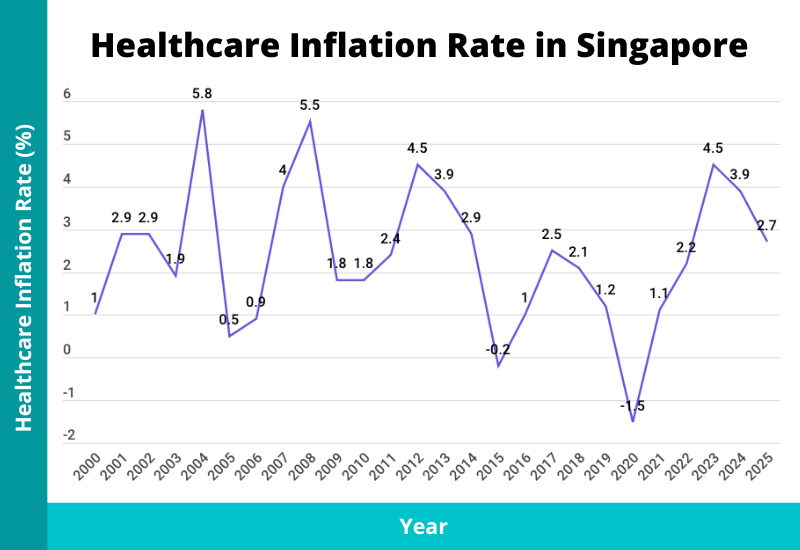
- Healthcare inflation ran at 2.7% in 2025, three times the headline rate, with costs up 59.1% since 2005
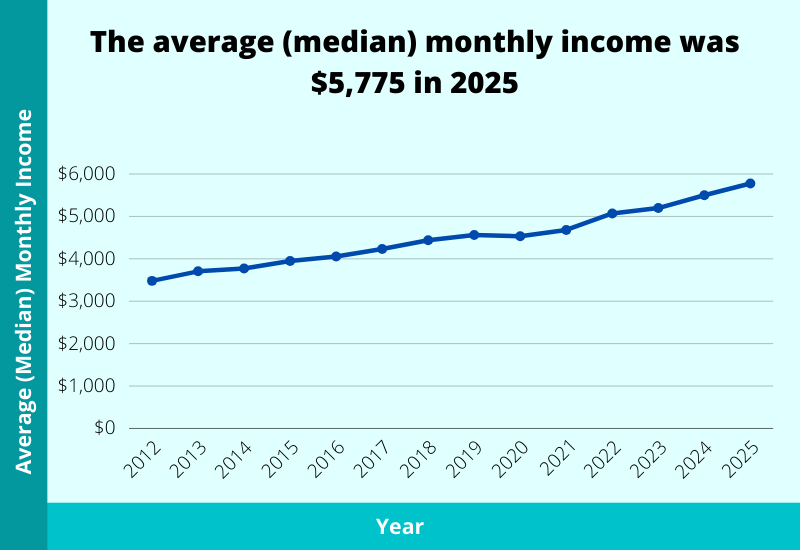
- The median gross monthly income reached $5,775 in 2025, up 46.2% over 10 years
SIDE NOTE
A policy bought years ago. Savings in three places. A will that's still on the to-do list.
None of it is wrong. It's just not a plan yet.
There's an order that turns the pieces into one system, and it doesn't require becoming a finance expert. Here's the order, in 7 steps, so you know what to sort out first.
1) Singapore was ranked the world’s most expensive city 9 times in 11 years
For the better part of a decade, Singapore sat at the top of the Economist Intelligence Unit’s (EIU) Worldwide Cost of Living survey, which compared the prices of around 200 products and services across more than 170 cities.
From 2014 to 2019, Singapore was ranked the world’s most expensive city to live in. Even during the COVID pandemic in 2020, it stayed in the top five. In 2022, Singapore regained the top spot, and in the 2023 edition it tied with Zurich as the world’s most expensive city. That made it 9 first-place finishes in 11 years.
The EIU has since discontinued the survey, according to research from NUS’s Asia Competitiveness Institute. So if you see Singapore’s “most expensive city” title quoted today, it is based on data that is no longer being updated.
Surveys that are still running put Singapore near the top too. Mercer’s Cost of Living City Ranking placed Singapore 2nd for international workers, behind Hong Kong and ahead of Zurich.
There is one caveat, though. These surveys reflect the cost of living of expatriates, not of typical Singaporean households. They don’t account for the subsidies and grants given to Citizens and Permanent Residents. Here are some of the reasons for the seemingly high cost of living in Singapore.
2) A single adult’s monthly cost of living runs $1,900 to $3,200 on a local lifestyle
What you spend each month depends far more on how you live than on where you live. A local taking the MRT and eating at hawker centres, and an expat renting a condo with a car in the driveway, pay very different amounts in the same city.
Our monthly cost of living breakdown tabulates estimated ranges for both, by household type:
| Household | Local lifestyle | Expat-style lifestyle |
|---|---|---|
| Single adult | $1,900 to $3,200 | $8,000 to $12,000 |
| Couple | $3,800 to $6,300 | $14,000 to $20,000 |
| Family of 4 | $4,600 to $8,500 | $20,000 to $28,000 |
The local ranges assume HDB living, mostly hawker food, and public transport. The expat ranges assume a whole condo unit, a car or heavy private-hire use, restaurants, and private healthcare. Rent, the car, and school fees explain most of the gap between the two.
If you live with your parents, take off the housing component, roughly $1,000 to $2,000 a month. Our own spending habits survey offers a closer look at what Singaporeans actually spend on.
3) Inflation fell to 0.9% in 2025, down from 2.4% in 2024
For 2025 as a whole, CPI-All Items (headline) inflation in Singapore averaged 0.9%, while MAS Core Inflation averaged just 0.7%, based on the Ministry of Trade and Industry’s December 2025 release. In 2024, the same figures were 2.4% and 2.8%.
After the spike of 2022 and 2023, price increases have slowed sharply.
This doesn’t mean prices are falling. It means they are rising more slowly than before. The higher price levels reached during 2022 and 2023 are unlikely to come back down.
So if your grocery bill still feels heavy even though the news says inflation has cooled, both things are true.
4) The average headline and core inflation rate over the past 20 years was 2.14% and 1.88% respectively
Inflation is measured by the change in the Consumer Price Index (CPI), which tracks the prices of things like housing, clothing, food, and healthcare.
Headline inflation measures the average change in prices of all goods and services, while core inflation excludes “Accommodation” and “Private Transport”. Core inflation is therefore a better indicator of the change in prices of everyday items.
SmartWealth’s analysis of SingStat CPI data shows that headline inflation in Singapore averaged 2.14% a year over the 20 years from 2005 to 2025. Here are the full results of our analysis of inflation in Singapore.
| Average Headline Inflation Rate (CPI All-Items) | Average Core Inflation Rate (MAS Core Inflation) | |
|---|---|---|
| Over the last 10 years (2015 to 2025) | 1.72% | 1.76% |
| Over the last 20 years (2005 to 2025) | 2.14% | 1.88% |
| Over the last 30 years (1995 to 2025) | 1.68% | 1.63% |
The average inflation rate is much higher than the interest a typical bank savings account pays, so money left in the bank loses value over time.
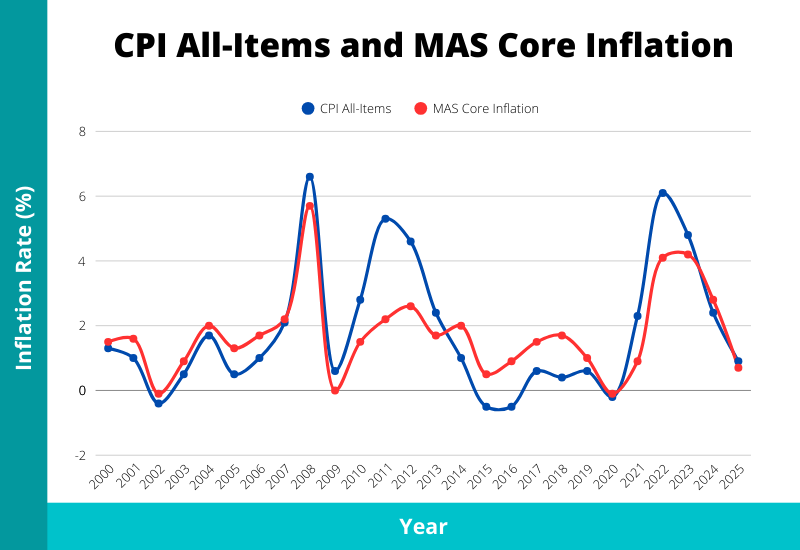
Core inflation peaked at 5.7% in 2008, when higher oil prices pushed prices up, and turned slightly negative at -0.2% in 2020 during the pandemic.
5) Prices of HDB resale flats have increased by 168.6% since 2000
Property prices here are high by the standards of most developed countries. Only a handful of cities, Hong Kong among them, are more expensive.
Here are the private residential property and HDB resale price indexes from 2000 to 2025:

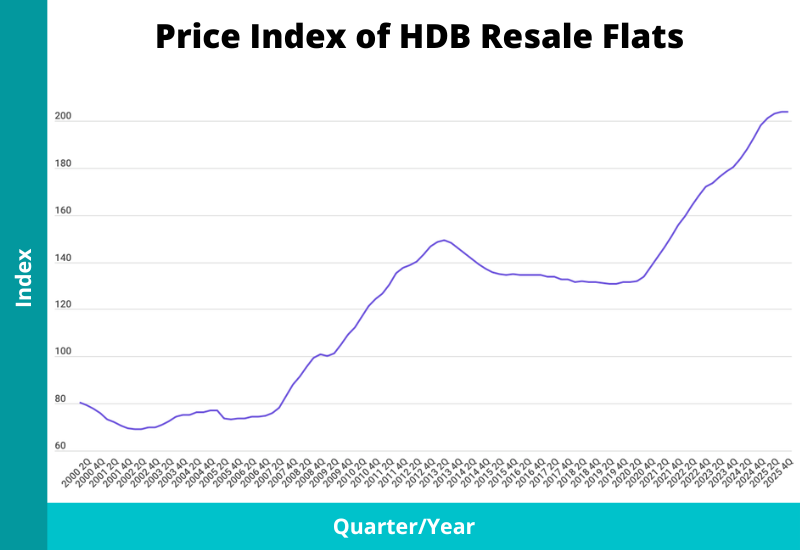
From 2000 to 2025, private residential property prices increased by 128.0%, while prices of HDB resale flats increased by 168.6%. Work-from-home arrangements and foreign investment pushed prices up sharply after 2020, and 1,594 million-dollar HDB flats changed hands in 2025, the highest in any year.
2026 has looked different. The HDB Resale Price Index fell 0.1% in 1Q2026, the first quarterly decline in nearly seven years, and slipped another 0.3% in 2Q2026. Private home prices rose just 0.5% in 2Q2026, the slowest pace in seven quarters, according to URA. The years of runaway growth appear to be cooling.
The table below shows the average and median prices for HDB resale flats, private condominiums, and landed properties. For the full picture, see our housing cost statistics.
| Housing Type | Average Price | Median Price |
|---|---|---|
| HDB flats | $652,498 | $628,000 |
| Condo | $2,128,942 | $1,875,000 |
| Landed | $5,928,412 | $4,650,000 |
6) The Category A COE premium hit a record $129,000 in July 2026
Buying and owning a private car costs more in Singapore than anywhere else in the world.
That is by design. The government keeps car ownership expensive to limit congestion and the land given over to roads and car parks. The main lever is the Certificate of Entitlement (COE), the right to own a car for 10 years, which is auctioned in limited quantities.
In the first bidding exercise of July 2026, the Category A premium (for smaller cars) closed at a record $129,000, based on COE bidding results. That is the price of the certificate alone, before the car.
A new Toyota Corolla Altis starts at $195,888 (as of August 2026), a price that already includes the COE. Even so, it excludes the running costs of petrol, parking, insurance, road tax, and maintenance.
| Cost of Running a Car | Monthly Average |
|---|---|
| Petrol | $250 to $400 |
| Parking (season pass plus public car parks) | $130 |
| Car insurance | $85 to $125 |
| Road tax | About $60 |
| Maintenance | $50 to $100 |
| Total | Around $600 to $800 |
QUICK CHECK
Can you answer these three questions?
1) If something happened to you tomorrow, how much would your family receive?
2) At 65, what monthly income will your savings and investments pay you?
3) If you never get round to a will, who inherits what, and in what proportion?
Most people manage one at best. Not because they're careless, but because nobody has shown them which order to tackle things in.
That order exists. Work through your finances in this sequence, from income and protection through to investments and estate planning.
7) GST rose from 8% to 9% on 1 January 2024
The Goods and Services Tax (GST) now stands at 9%, after a two-step increase from 7%, first to 8% on 1 January 2023, then to 9% on 1 January 2024.
Unlike inflation, which varies by category, a GST increase touches nearly everything you pay for, including groceries, utilities, insurance premiums, and meals out.
A two percentage point increase sounds small, but on a household spending $5,000 a month, it works out to roughly $100 more every month than under the old 7% rate.
The government has cushioned the increase for lower- and middle-income households through the Assurance Package and the permanent GST Voucher scheme, which we cover later in this article.
8) The cost of education has increased by 69.6% from 2005 to 2025
The cost of education has risen by 69.6% over the past 20 years. Benchmarked against CPI-All Items inflation (52.8% over the same period), that is a considerable premium.
Demand explains much of it. More young Singaporeans want a degree, in an economy that rewards one with better openings and better pay.
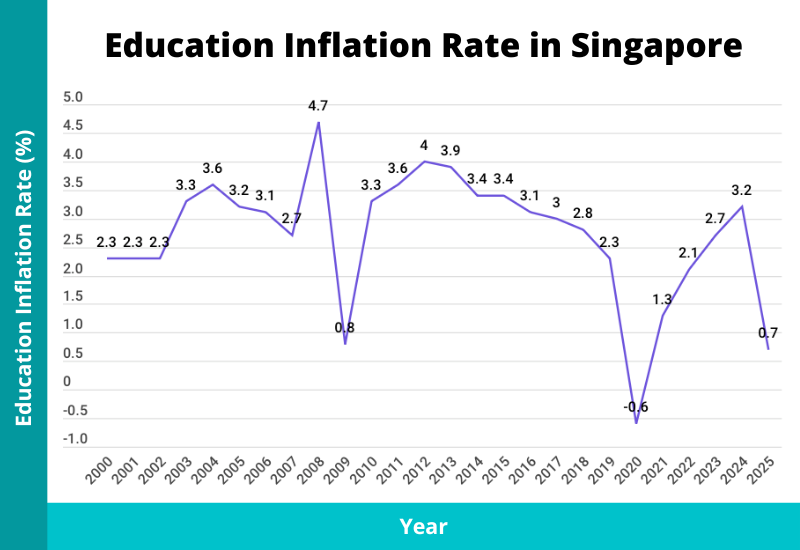
The chart above tracks the inflation rate for education in Singapore, which averaged 2.68% a year over the past 20 years. Prices rose every year except 2020, when local universities held tuition fees.
In 2026, the estimated tuition fees for a four-year general course at a local public university are $38,790. Add a student’s living expenses, and the total cost of a degree comes close to $80,000 in today’s value.
9) The healthcare inflation rate in 2025 was 2.7%
Healthcare is another area where the cost keeps climbing, and it has drawn attention since the MediShield Life review.
Healthcare costs increased by 59.1% from 2005 to 2025, an average of 2.35% per year. Healthcare inflation in 2025 (2.7%) ran at three times the headline rate (0.9%), so medical costs kept rising even as overall inflation cooled.
A few forces are pushing medical costs up. A longer life expectancy means more care in old age, better technology and screening catch conditions earlier, and manpower and operating costs keep rising.
Health insurance premiums are climbing too. Following the 2024 MediShield Life review, premiums are rising in phases from April 2025, in exchange for higher claim limits. Integrated Shield Plan riders have shifted too. The old “full” riders gave way to a 5% co-payment back in 2019, and from April 2026, the new riders no longer cover the deductible and raise the annual co-payment cap to $6,000, in return for premiums around 30% lower.
10) 90% of food is imported, and water prices have risen
Did you know that more than 90% of the food consumed in Singapore is imported?
Even water is partly imported from Malaysia. With little land and few natural resources, Singapore produces only a fraction of its own food, so food prices here move with global supply disruptions, currency swings, and our neighbours’ export policies.
The government works to keep supplies stable by diversifying import sources and growing local production. Even so, a poor harvest or an export ban abroad can move food prices here within weeks.
Utilities have risen too. Water prices increased by 50 cents per cubic metre in two phases, 20 cents in April 2024 and 30 cents in April 2025, the first revision since 2017. For a typical HDB household, that works out to a few dollars more a month, partly offset by U-Save rebates.
11) The median gross monthly income has grown by 46.2% over the past 10 years
Fortunately, incomes have grown too, and faster than prices.
| Year | Median Monthly Income (Including Employer CPF Contributions) |
|---|---|
| 2015 | $3,949 |
| 2016 | $4,056 |
| 2017 | $4,232 |
| 2018 | $4,437 |
| 2019 | $4,563 |
| 2020 | $4,534 |
| 2021 | $4,680 |
| 2022 | $5,070 |
| 2023 | $5,197 |
| 2024 | $5,500 |
| 2025 | $5,775 |
In 2015, the median gross monthly income was $3,949. By 2025, it had risen 46.2% to $5,775. After inflation, that is real growth of around 2.1% a year, so the typical worker’s pay has outpaced the cost of living, even through the 2022 to 2023 spike.
The median tells only part of the story. Gains have not been spread evenly, and our income inequality statistics show how the picture differs across income groups. For a household view, see the average household income in Singapore.
12) Government support offsets part of the squeeze
The headline rankings leave something out. Singaporean households get offsets that expatriates don’t.
Through Budget 2026, every Singaporean household received CDC vouchers, eligible adults received a cost-of-living cash payment, and HDB households received U-Save rebates that cover several months of utility bills. These sit on top of permanent schemes such as the GST Voucher and the ongoing Assurance Package.
Those are the one-off payouts. The larger story is the support that runs year after year. In 2025, resident households received an average of $7,300 per household member in government transfers, through schemes like Workfare, the GST Voucher, and subsidised healthcare and education. Lower-income households received far more than the average. Those in one- and two-room HDB flats received the most, an average of $16,519 per member.
This support doesn’t erase the cost pressures households feel, but it does mean the global rankings overstate what a typical resident household actually pays.
What Can You Do About the High Cost of Living?
The statistics above are largely beyond any individual’s control. What we can control is how we manage our finances and lifestyle choices.
Make full use of the government schemes you qualify for, and be deliberate about the big-ticket decisions. Reconsidering car ownership, for instance, has a far bigger impact than skipping coffees. With a Cat A COE at $129,000, choosing public transport or private hire over a new car can free up over $1,000 a month.
Foreigners face a higher cost of living than locals, since they don’t receive the same grants and subsidies. If you’re planning a move here, work out carefully whether your current lifestyle survives the change.
Whether you’re a local or a foreigner, one way to keep expenses in check is to know how to budget effectively.
BEFORE YOU GO
Articles can tell you what generally makes sense. They can't see your policies, your CPF, or your plans.
FullCircle is our comprehensive financial planning session. A licensed consultant goes through what you have, shows you the gaps and overlaps, and tells you what to prioritise across protection, retirement, and estate planning.
It's complimentary, takes about 45 minutes, and if nothing needs changing, we'll say so.