

While most parents hope that their child can study in one of the six local universities in Singapore, this may not always be possible for a range of reasons.
For one, some students are unable to produce the minimum results to gain entry into the local university and course of their choice.
Next, your child may be interested in pursuing a course that is not offered here, such as Veterinary Science, which no local university currently offers as an undergraduate degree.
Lastly, the child may want to study at one of the more prestigious universities overseas, where many well-known professors and experts are based.
As a parent, you likely want to give your child the widest range of opportunities. In this article, we look at the cost of an overseas university education, and how to fund it using various financial tools, should the need arise.
In a Nutshell
The most popular destinations for tertiary education are the United States, Australia, and the United Kingdom. In the table below, we compare the cost of a full engineering degree, a common choice among Singaporean students, at one well-known university in each country.
| Course Length | Tuition Fees (full course) | Living & Other Costs (full course) | Total (tuition + living) | |
|---|---|---|---|---|
| United States | 4 years | USD $266,880 | USD $104,160 | USD $371,040 (SGD $478,642*) |
| Australia | 4 years | AUD $246,000 | AUD $118,840 | AUD $364,840 (SGD $324,708*) |
| United Kingdom | 3 years | £106,590 | £42,156 | £148,746 (SGD $257,331*) |
*Conversions use market rates on 14 July 2026: US$1 = S$1.29, A$1 = S$0.89, £1 = S$1.73. Tuition multiplies the current annual international fee by the course length: MIT (2026/27), UNSW Sydney’s Bachelor of Engineering (Honours) (2026 indicative first-year fee), and the University of Warwick’s BEng (2026/27). Universities typically raise fees each year, so treat these totals as a minimum. Living and other costs use MIT’s published non-tuition cost of attendance for the US, the Australian student visa financial requirement of A$29,710 a year, and the UK student visa living cost benchmark of £1,171 a month (outside London). A UK bachelor’s degree typically takes three years rather than four, which is one reason the UK total is the lowest.
Read on for the fees of other courses.
SIDE NOTE
A policy bought years ago. Savings in three places. A will that's still on the to-do list.
None of it is wrong. It's just not a plan yet.
There's an order that turns the pieces into one system, and it doesn't require becoming a finance expert. Here's the order, in 7 steps, so you know what to sort out first.
3 Benefits of Studying Overseas
Apart from giving students access to one of the best schools for their degree of choice, there are other benefits of studying overseas that can help set your child up for life.
For one, your child will pick up essential life skills as they start living on their own for the first time. They will have to manage their own money, do the chores, cook, and clean their laundry. If you have been trying for years to get them to help around the house without much luck, moving abroad tends to do what nagging could not.
Next, living among people who grew up differently tends to broaden how your child sees the world. Students who have studied abroad often come back more open-minded, and quicker to question assumptions they once took for granted.
Finally, studying overseas will push your child to become financially savvy. They will need to learn how to organise and stick to their budget, and manage tasks like going to the bank and paying their own university bills. Few Singaporean children get this practice, as parents often handle all the money, sometimes right up until their children are married adults. Having to juggle real bills at 19 teaches them what things actually cost.
So if your child asks to study overseas, don’t reject the request out of hand. Some of the skills and benefits listed above cannot be “bought” or learned fully if they only stay in Singapore.
How Much Does It Cost to Study Abroad?
Based on 2026/27 fees and official living cost benchmarks, a full overseas degree costs roughly $257,000 to $479,000 in Singapore dollars, depending on the country, university, and course.
The table above gave you the figures for an engineering degree at MIT, UNSW Sydney, and the University of Warwick.
What if your child wants to read another course?
In the sections below, we provide a range of tuition fees for the most popular courses pursued in the USA, Australia, and the UK.
United States
The United States is a popular destination for tertiary education. Apart from being known for the prestigious Ivy League schools, it is often valued for networking opportunities and strong job prospects. Among the most popular undergraduate degrees pursued by Singaporeans in the USA are Engineering, Philosophy, Politics and Economics, and Business.
Tuition fees
In the table below, we look at three popular universities in the USA and their 2026/27 tuition fees (for four years). Note that this is the tuition figure alone, and most universities increase their fees each year. Prices are quoted in USD.
| University | Annual tuition (2026/27) | 4-year tuition |
|---|---|---|
| Massachusetts Institute of Technology (MIT) | $66,720 | $266,880 |
| Harvard University | $62,226 | $248,904 |
| Columbia University | $72,800 | $291,200 |
Living expenses
Living expenses vary with your child’s lifestyle and, in large part, with where the university is located. Each university publishes an estimate for housing and food, which we have extracted below. These figures cover on-campus housing and meals, but not transport, travel home, or personal spending. Prices are quoted in USD, per year.
| University, City | Housing & food (per year) |
|---|---|
| Massachusetts Institute of Technology, Cambridge | $22,194 |
| Harvard University, Cambridge | $23,192 |
| Columbia University, New York | $19,650 |
Australia
Many Singaporeans who study in Australia read Medicine, Physiotherapy, and Psychology, as Australia’s health sciences are world-renowned and, in some cases, easier to enter than the equivalent courses here.
QUICK CHECK
Can you answer these three questions?
1) If something happened to you tomorrow, how much would your family receive?
2) At 65, what monthly income will your savings and investments pay you?
3) If you never get round to a will, who inherits what, and in what proportion?
Most people manage one at best. Not because they're careless, but because nobody has shown them which order to tackle things in.
That order exists. Work through your finances in this sequence, from income and protection through to investments and estate planning.
Tuition fees
Tuition for the health sciences tends to be higher, as it is in Singapore. The table below shows the 2026 indicative annual international fees at three popular universities. All prices are in AUD, per year.
| University | Medicine / Biomedical Science | Psychology | Physiotherapy |
|---|---|---|---|
| University of Sydney | $60,600 | $56,300 – $60,600* | $60,600 |
| University of Melbourne | $54,780 – $61,460** | $52,944 – $62,208** | $52,944 – $62,208** |
| University of Queensland | $60,952*** | –*** | –*** |
*The University of Sydney does not price psychology separately. The range shown is its 2026-entry undergraduate fee band for science degrees, which cover psychology.
**The University of Melbourne teaches biomedicine, psychology, and physiology within its Bachelor of Biomedicine and Bachelor of Science, rather than as standalone degrees. Figures are 2026 indicative first-year fees, which vary by the subjects chosen.
***The University of Queensland fee shown is its published annual fee for the 2027 fee year, the latest available. UQ offers psychology and physiotherapy within broader health and science degrees, and the exact fee varies by course.
Living expenses
To grant a student visa, the Australian Department of Home Affairs requires a single student to show at least A$29,710 a year for living costs, which works out to about A$2,476 a month for accommodation, food, utilities, and everyday expenses. Even the department notes that actual living costs can be much higher, depending on the city and lifestyle. In Sydney, for example, the University of Sydney’s living costs guide estimates monthly accommodation at A$980 to A$3,500 and food at A$1,000 to A$2,500. Compulsory Overseas Student Health Cover is an additional cost.
United Kingdom
The United Kingdom is a popular choice for those wanting to read Economics, Arts and Social Sciences, and Law. Popular universities include the London School of Economics, the Universities of Cambridge and Oxford, and the University of Edinburgh. In recent years, the University of Warwick has been a common choice for Singaporeans reading Law. As of 14 July 2026, the exchange rate is around £1 to S$1.73. The fees below are quoted in pounds, per year.
Tuition fees
Unlike US universities, most UK universities charge different overseas fees by subject, so many are shown as a range. The figures below are for 2026/27 entry.
| University | Annual overseas fees (2026/27) |
|---|---|
| London School of Economics | Around £29,600 |
| University of Cambridge | £29,052 – £70,554 (clinical medicine highest) |
| Oxford University | £37,380 – £62,820 |
| University of Warwick | £27,870 (law and arts) – £35,530 (sciences) |
Living expenses
Those studying in London should expect a higher cost of living, as accommodation is the biggest driver. For a student visa, the UK Home Office asks you to show £1,529 a month for courses in London and £1,171 a month elsewhere, for up to nine months. Actual spending over a full year is often higher, and studying in a smaller university town such as Coventry, Cambridge, or Edinburgh can reduce accommodation costs, though you may then spend more on transport and travel into the larger cities.
All in, you would need to budget between $257,331 and $478,642 (based on the summary table above) to send your child overseas for an engineering degree, with living costs making up roughly a quarter to a third of the total.
In Comparison: The Costs of Studying in a Local University
If you compare the tuition fees for a Singapore university with those in the USA, Australia, and the UK, the difference is stark. Local tuition rates sit far below the overseas figures above.
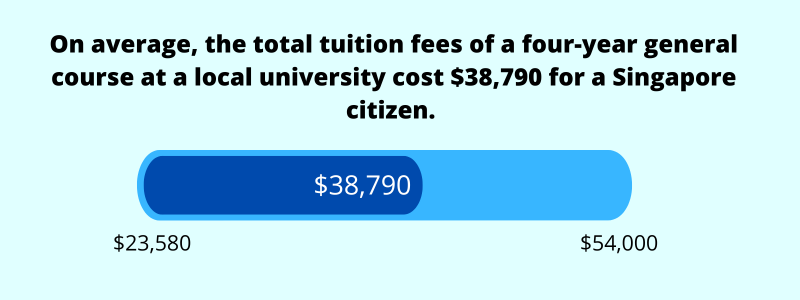
Living expenses are much lower too, as your child can save by staying and dining at home. Even if they choose to live in a university residence here, the cost will not be as high as living overseas, and you save on that yearly flight home.
How to Fund the Rising Costs of Education
Saving up for your children’s education takes years of steady planning.
The figures above are for the 2026/27 academic year. By the time your child is ready for university, the costs will likely be higher due to inflation. In a survey we conducted, 2 in 3 respondents felt that getting a degree is expensive, though a good proportion still felt it was worth it. Our wider education cost statistics show the same upward trend across the board.
How much higher should you expect the cost to be for both tuition and living expenses?
We have created a calculator to project the rate of inflation and the estimated cost of funding a local or an overseas university education by the time your child enrols. Visit this page to project the total amount you may need to save.
With that, you might be wondering, how can I fund such a hefty sum?
There are four main ways: taking a loan, saving in the bank, investing, and endowment plans. In this article, we explore the pros and cons of each. One popular option is a child education endowment plan, as it is usually capital guaranteed upon maturity and offers higher potential returns than saving purely in the bank.
BEFORE YOU GO
Articles can tell you what generally makes sense. They can't see your policies, your CPF, or your plans.
FullCircle is our comprehensive financial planning session. A licensed consultant goes through what you have, shows you the gaps and overlaps, and tells you what to prioritise across protection, retirement, and estate planning.
It's complimentary, takes about 45 minutes, and if nothing needs changing, we'll say so.