

Modern medicine can keep a body going long after recovery has stopped being possible.
That’s a comfort in many cases, and a quiet fear in others: being kept alive by machines when the dying has already begun, with no way left to say “enough”.
An Advance Medical Directive is how you settle that question in advance, while you’re well and clear-headed. It’s one of the most misunderstood documents in Singapore, so here’s exactly what it does, what it doesn’t, and how to make one.
Too Long; Didn’t Read
An Advance Medical Directive (AMD) is a legal document that tells your doctor not to use extraordinary life-sustaining treatment to artificially prolong your life if you’re ever terminally ill and unconscious. It lets you die naturally when that point is genuinely reached.
It’s narrow and heavily safeguarded. It isn’t euthanasia, it isn’t a general “do not treat”, and ordinary care like pain relief always continues. Anyone aged 21 and above who isn’t mentally disordered can make one through a doctor with two witnesses, then register it with MOH. You can revoke it at any time.
The AMD sits alongside Advance Care Planning (ACP) and a Lasting Power of Attorney (LPA) as part of planning for a time when you can’t speak for yourself.
SIDE NOTE
A policy bought years ago. Savings in three places. A will that's still on the to-do list.
None of it is wrong. It's just not a plan yet.
There's an order that turns the pieces into one system, and it doesn't require becoming a finance expert. Here's the order, in 7 steps, so you know what to sort out first.
What Is an Advance Medical Directive?
An Advance Medical Directive (AMD) is a legal document you sign in advance to inform the doctor treating you that, if you ever become terminally ill and unconscious, you don’t want extraordinary life-sustaining treatment used to prolong your life.
MOH’s reasoning for it is straightforward. Medical technology can prolong life in the final stages of a terminal illness, but it can’t stop the dying process. At that point, further intervention is medically futile. An AMD lets you say, ahead of time, that you’d rather be spared it and allowed to go naturally, in peace and with dignity.
“Extraordinary life-sustaining treatment” means interventions that only postpone the moment of death without any real prospect of recovery, such as a ventilator breathing for you or tube feeding when your body is already shutting down. It does not cover ordinary care. Pain relief, nursing, and comfort care continue no matter what, so an AMD never means being left to suffer.
What an AMD Is Not
Most of the worry around AMDs comes from a few common misunderstandings. Worth clearing up:
- It isn’t euthanasia. Euthanasia, which actively ends a life, is illegal in Singapore. The Advance Medical Directive Act is explicit that it permits only natural death, and condones neither mercy killing nor euthanasia. An AMD does the opposite of acting: it declines treatment that would only prolong an unavoidable death. One ends life, the other allows it to take its course.
- It isn’t a general “do not treat” or DNR. It applies only in the narrow case of terminal illness with unconsciousness, not to everyday medical decisions or recoverable conditions.
- It doesn’t stop comfort care. You’ll still receive pain management and nursing. An AMD removes only the futile, not the humane.
- It isn’t easy to trigger. As we’ll see, several doctors must agree you’re terminally ill before it ever takes effect.
Who Can Make an AMD
Anyone who is aged 21 and above and not mentally disordered can make an AMD. You don’t need a lawyer or any legal advice to do it.
Making one is entirely voluntary. In fact, it’s a criminal offence for anyone to force you into making an AMD, or to require it as a condition of being insured or receiving care. The decision is yours alone.
QUICK CHECK
Can you answer these three questions?
1) If something happened to you tomorrow, how much would your family receive?
2) At 65, what monthly income will your savings and investments pay you?
3) If you never get round to a will, who inherits what, and in what proportion?
Most people manage one at best. Not because they're careless, but because nobody has shown them which order to tackle things in.
That order exists. Work through your finances in this sequence, from income and protection through to investments and estate planning.
How to Make an AMD
There are three steps.
1. Get the form. AMD forms are available from medical clinics, polyclinics, and hospitals, or you can download the form and bring it to your doctor.
2. Sign it before two witnesses. You make the AMD through a doctor, who must confirm that you understand what you’re doing, aren’t mentally disordered, and aren’t being pressured. You then sign in front of two witnesses at the same sitting. One witness must be the doctor. The second must be 21 or older. To keep things clean of any conflict of interest, neither witness may be an immediate family member, a beneficiary under your will or insurance, or anyone entitled to your CPF on your death.
3. Register it with MOH. Send the completed form, in a sealed envelope, by post or by hand to the Registrar of Advance Medical Directives at the Ministry of Health. Your AMD is only valid once registered, and the Registrar will send you an acknowledgement once it’s done. Faxed copies aren’t accepted.
When an AMD Takes Effect
This is the part that reassures most people. An AMD doesn’t hand anyone a hair-trigger.
Before it can be acted on, you must first be certified as terminally ill. According to the Ministry of Health, three doctors, including the doctor in charge of your care, must unanimously agree that you’re terminally ill. Under the law’s certification rules, at least two of the three must be specialists.
If that first panel can’t reach a unanimous view, the matter goes to a second panel of three specialists appointed by MOH. If they also can’t agree, the AMD cannot take effect, and your treatment continues as normal. Only when terminal illness is confirmed, and you’re unconscious and unable to communicate, does the AMD come into play.
One more point that puts families at ease: a valid, registered AMD is your own legal decision, and your family cannot overrule it.
How to Revoke an AMD
You’re never locked in. An AMD can be revoked at any time, as long as one witness is present. You can do it in writing using the revocation form, or even verbally, and the revocation is then sent to the Registrar. Because it’s this easy to undo, there’s little reason to hold off making one out of fear of changing your mind later.
How the AMD Fits with ACP and LPA
The AMD is one of three tools for planning ahead, and it’s the narrowest of them.
Your Advance Care Plan is the broad conversation about your values and care wishes, and it names who should speak for you. It guides, but isn’t legally binding. Your Lasting Power of Attorney hands someone you trust the legal authority to make welfare and financial decisions if you lose mental capacity. The AMD covers just one specific decision: refusing treatment that would only stretch out an unavoidable death.
They don’t compete. On the narrow question of extraordinary life-sustaining treatment, your AMD is the legal instruction, and not even an LPA donee can override it. The other day-to-day decisions fall to your donee and spokesperson, guided by your ACP. Most people benefit from having all three in place.
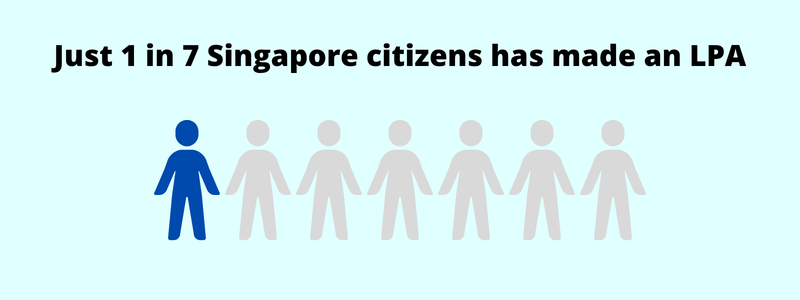
Take-up of all three is still patchy, though. Only about 1 in 7 Singapore citizens have made an LPA, and completed Advance Care Plans skew heavily towards the over-50s, as the wider take-up figures show.
The tools are there, most people just haven’t got to them yet.
The Bottom Line
An AMD is a short document that spares your loved ones an agonising decision at the worst possible moment, and spares you a prolonged, futile death you never wanted. It’s voluntary, free of any government fee to register, safeguarded by multiple doctors, and reversible at any time.
If you’re thinking it through, the natural next step is to round out the picture: complete your Advance Care Plan, make an LPA, write a will, and sort the basics of your estate plan. Each one covers something the others can’t.
BEFORE YOU GO
Articles can tell you what generally makes sense. They can't see your policies, your CPF, or your plans.
FullCircle is our comprehensive financial planning session. A licensed consultant goes through what you have, shows you the gaps and overlaps, and tells you what to prioritise across protection, retirement, and estate planning.
It's complimentary, takes about 45 minutes, and if nothing needs changing, we'll say so.