

Singapore’s education system is taken very seriously, and for good reason. The island nation suffers from a lack of natural resources and thus relies heavily on human capital, seen as one of the keys to its strong economy and high Gross Domestic Product (GDP).
Education in Singapore can be expensive, but it is considered necessary, much like the saving up and investing required to afford it.
While Singapore citizens pay heavily subsidised prices, the costs are significantly higher for foreign and international students.
Let’s look at the notable statistics on the cost of education in Singapore.
Note: All figures are in Singapore dollars (SGD).
Top Education Cost Statistics
- The average total cost of education in Singapore is estimated to be $77,739
- SmartWealth projects the full education journey for a child born in 2026 at around $170,000, once university tuition and four years of living costs are future-valued
- Non-citizens (i.e., PRs and foreigners) should expect to pay multiple times the cost borne by citizens
- The average cost of university tuition fees in Singapore is $38,790. Including living costs, the total estimated figure to obtain a university degree is $81,890
- Singapore households spent an average of $104.80 a month on private tuition in 2023, or an estimated $1.8 billion in total
- Average monthly household spending on education reached $404 in 2023, more than triple the roughly $116 of 1993
- A full overseas degree costs roughly $257,000 to $479,000 at 2026/27 fees, including living costs, in the UK, Australia, and the US
- 2 in 3 adults in Singapore think that university education is expensive
- 71.3% of those who consider a university degree expensive still believe that it is worth the cost
- The education inflation rate in Singapore was 0.7% in 2025
- From 2005 to 2025, the cost of education increased by 69.6%
- Over the past 20 years, the average education inflation rate was 2.68% per year
- The budgeted government expenditure on education for FY2026 is $16.45 billion, representing 2% of GDP
SIDE NOTE
A policy bought years ago. Savings in three places. A will that's still on the to-do list.
None of it is wrong. It's just not a plan yet.
There's an order that turns the pieces into one system, and it doesn't require becoming a finance expert. Here's the order, in 7 steps, so you know what to sort out first.
Education Cost Inflation
Education is not immune to inflation. However, the rates at which education inflation takes place do not necessarily match headline or core inflation.
For instance, in 2025, headline inflation was 0.9%. According to the Monetary Authority of Singapore (MAS), headline inflation takes into account consumer prices, including those of key categories of goods and services, accommodation and private road transport.
Meanwhile, core inflation in 2025 was a lower 0.7%. Core inflation takes into account consumer prices in key categories of goods and services but excludes accommodation and private road transport.
By contrast, the education inflation rate in Singapore was just 0.7% in 2025, indicating that the cost of education rose at a slower pace than the general cost of living.
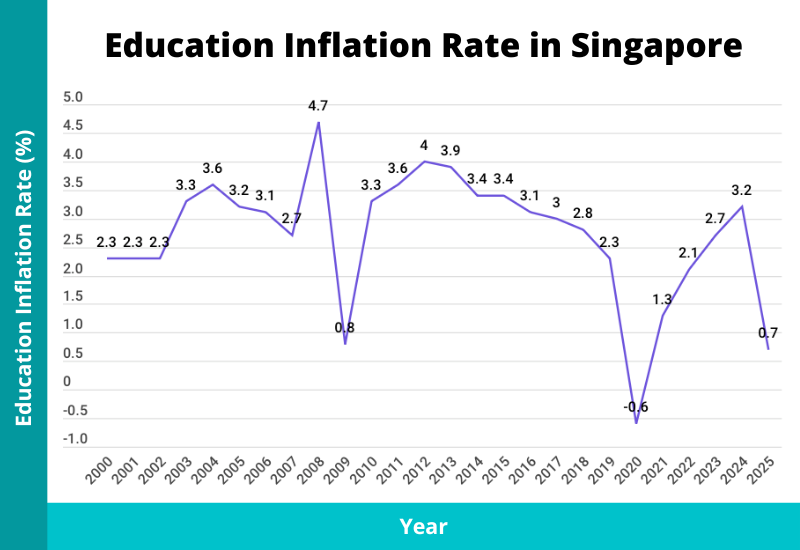
As the above chart shows, the cost of education has risen every year, the only exception being from 2019 to 2020.
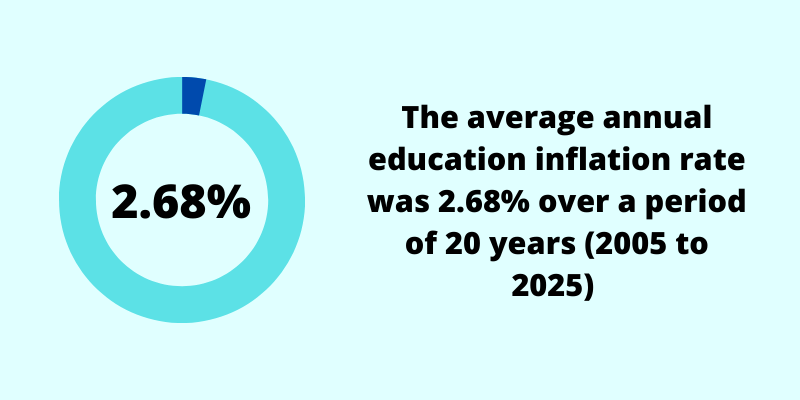
From 2005 to 2025, the cost of education increased by a total of 69.6%. The average education inflation rate over the same 20-year period was 2.68% per year.
Total Cost of Education
Although school fees are subsidised for Singapore citizens, the total cost of a student’s entire educational journey can still be considerable.
The average total cost of education in Singapore is estimated at $77,739.

Here is a breakdown of typical costs at the various education levels.
| Education Level | Term | Average Cost |
|---|---|---|
| Infant Care | 16 months | $11,938.40 |
| Child Care | 66 months | $24,083.40 |
| Primary School | 6 years | $936 |
| Secondary School | 4 years | $1,200 |
| Junior College (JC) | 2 years | $792 |
| Polytechnic | 3 years | $9,300 |
| Institute of Education (ITE) | 3 years | $1,590 |
| University | 4 years | $38,790 |
These estimates assume the following about the child in question:
- The child is a Singapore citizen
- Both of his or her parents are working full-time and have a median household income
- The educational pathway commences in full-day infant care followed by full-day child care
- The child attends only government schools
- The child goes to university by way of Junior College, without enrolling at a polytechnic
- The above figures are not adjusted for inflation and do not take into account the cost of living or the price of miscellaneous items
Those figures are in today’s dollars. Projected forward for a child born in 2026, SmartWealth estimates the full journey at around $170,000, once university tuition is grown at education inflation and four years of living costs are added. If education inflation runs closer to 4% a year, the total climbs to roughly $190,000. These are projections, not certainties.
Household Spending on Tuition and Education
The average Singapore household spent $104.80 a month on private tuition in 2023, up from $88.40 in 2018, based on the Household Expenditure Survey by the Singapore Department of Statistics.
That average includes the many households that pay nothing for tuition, so families that do engage tutors typically spend a good deal more. Across the whole population, families here spent an estimated $1.8 billion on private tuition in 2023.
Tuition sits inside a wider rise in education spending. Average monthly household spending on education, which covers school fees, tuition, enrichment, and materials, reached $404 in 2023, up from $374 in 2018 and more than triple the roughly $116 of 1993.
| Year (Household Expenditure Survey) | Average monthly tuition spend | Average monthly education spend |
|---|---|---|
| 2018 | $88.40 | $374 |
| 2023 | $104.80 | $404 |
Between the two surveys, tuition spending grew faster (about 19%) than education spending overall (about 8%), so tuition is taking up a growing share of the family education budget.
These tutoring fees are on top of school fees, not part of the $77,739 total above. What a family actually pays depends on the going tuition rates, which in 2026 run from about $25 an hour for a student tutor at lower primary to $150 an hour for an ex-MOE teacher at JC level. At those rates, SmartWealth estimates that weekly one-to-one tuition in a single subject, from Primary 1 to the O-levels, costs about $38,400.
One caveat: the survey runs once every five years, so 2023 is the latest reading, and it measures what households spend rather than what tutors charge.
QUICK CHECK
Can you answer these three questions?
1) If something happened to you tomorrow, how much would your family receive?
2) At 65, what monthly income will your savings and investments pay you?
3) If you never get round to a will, who inherits what, and in what proportion?
Most people manage one at best. Not because they're careless, but because nobody has shown them which order to tackle things in.
That order exists. Work through your finances in this sequence, from income and protection through to investments and estate planning.
Cost of University
Singapore’s public universities do fairly well on global university ranking lists, so it comes perhaps as no surprise that university fees, while subsidised for Singapore citizens, are significant.
The average cost of a 4-year general undergraduate university degree is currently $38,790 for Singapore citizens.
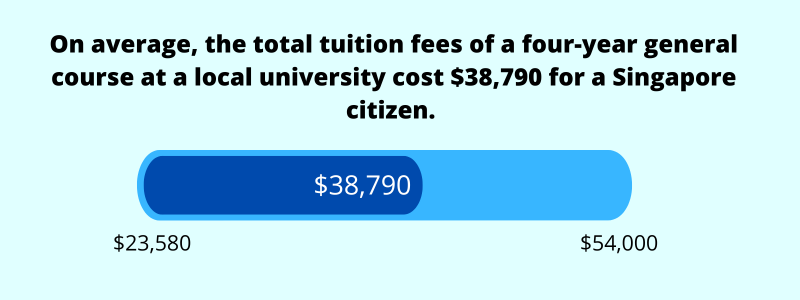
Throughout a child’s educational journey, university fees are likely to be the category contributing most heavily to the overall cost of education. To make matters worse, tuition fees are not the only costs incurred by university students.
The estimated living costs a student will incur over a 4-year university career, excluding tuition fees, add up to $43,100.
In total, a student would thus incur $81,890 over the course of a four-year undergraduate degree programme, including tuition fees and living costs. It is possible to lower these costs if the student can live at home with his or her family, however, there might be an opportunity cost of lost rental income for households who would otherwise rent out the student’s room in their absence.
The above estimates are for Singaporean citizen undergraduates attending local public universities. Singaporeans studying overseas can expect to pay far more. At 2026/27 fees, a full overseas university education costs roughly $257,000 in the UK, $325,000 in Australia, and $479,000 in the US, including living costs.
What do Singaporeans think? We surveyed 1,088 adults aged 18 and above to gather their thoughts about the cost of university education in Singapore.
According to our survey, 2 in 3 adults in Singapore think that university education is expensive.
However, 71.3% of those who consider a university degree expensive still believe that it is worth the cost.
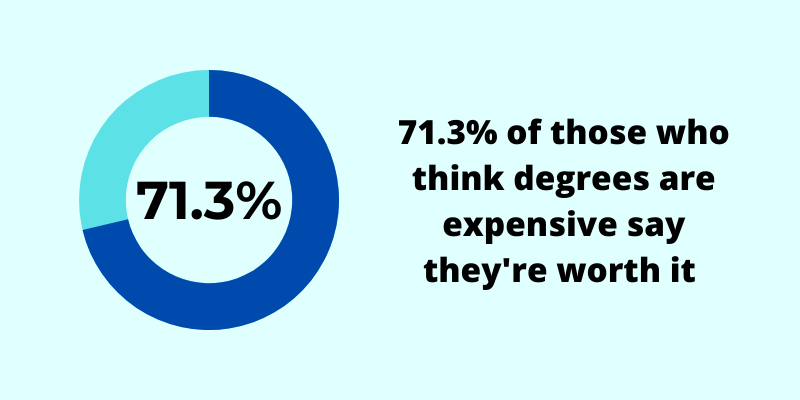
This attitude speaks volumes about the perceived worth of a university education in Singapore, particularly in the job market.
Cost of Education for PRs and Foreigners/International Students
In the case of non-Singapore citizens, residency status has a significant influence on the cost of education. While non-citizens are not entitled to the same heavy government subsidies that Singapore citizens receive, they might still enjoy more modestly subsidised prices depending on their residency status and/or country of origin.
Amongst non-citizens, permanent residents (PRs) pay the lowest education costs.
Amongst those without PR status, international students from the ASEAN region frequently pay lower costs than international students from outside the ASEAN region.
Despite the availability of subsidies in select cases, PRs and foreigners should still be prepared to pay multiple times the cost borne by Singapore citizens.
To illustrate the disparity in costs, the tables below compare the fees paid by Singapore citizens, PRs, and foreigners.
Here are the monthly costs for infant and child care at an ECDA-licensed centre (AOP):
| Education Level | Singapore Citizens (SCs) | Permanent Residents (PRs) | Foreigners |
|---|---|---|---|
| Infant Care (Full-Day) | $746.15 | $1,863.90 | $2,330.42 |
| Child Care (Full-Day) | $364.90 | $910.15 | $1,277.48 |
Note: The fees for Singapore citizens indicated above take into account subsidies received by households earning the median income in which the mother is working.
PRs pay 2.5 times the cost of what Singapore citizens pay, while foreigners pay about 3 times.
Once a child enrols in primary school, PR and foreign households will find themselves paying many times what Singapore citizens pay.
Here are the monthly costs of education from primary school to pre-university level.
| Education Level | Singapore Citizens (SCs) | Permanent Residents (PRs) | Foreigners / International Students (ASEAN) | Foreigners / International Students (non-ASEAN) |
|---|---|---|---|---|
| Primary School | $13 | $293 to $343 | $559.17 to $609.17 | $949.17 to $1,049.17 |
| Secondary School | $25 | $580 to $700 | $991.80 to $1,111.80 | $1,931.80 to $2,211.80 |
| Junior College (Pre-University) | $33 | $667 to $787 | $1,199.43 to $1,319.43 | $2,289.43 to $2,569.43 |
As the above table shows, PRs pay approximately 20 times what Singapore citizens pay, while ASEAN and non-ASEAN international students pay 40 and 70 times more respectively. The high costs for international students have possibly been set as a response to international school fees in Singapore.
Finally, the table below indicates the cost of a 4-year general undergraduate degree at a local university.
| Education Level | Singapore Citizens (SCs) | Permanent Residents (PRs) | ASEAN Foreigners / International Students (Subsidised) | Other Foreigners / International Students (Subsidised) | Non-Subsidised Students |
|---|---|---|---|---|---|
| University (4-year general course) | $38,790 | $61,900 | $89,635 | $96,655 | $162,200 |
At the university level, PRs pay about 59.6% higher fees than Singapore citizens.
Subsidised international students pay 140% more than Singapore citizens, while non-subsidised students pay 300% more. Most international students are eligible for subsidised fees, however, they must serve a 3-year bond after graduation.
Due to the heavy subsidies at local universities, parents intending to enrol their Singapore citizen children in a private educational institution can generally expect fees to be significantly higher. However, that is not always the case for international students, who might find certain private educational institutions more affordable.
Government Expenditure/Spending on Education
So, how much has the government been spending on education over the years?
In FY2026, the total government expenditure on education reached approximately $16.45 billion, up from $15.12 billion in FY2025. This continues a broadly upward trend in absolute spending that has persisted for over a decade.
| 2026 | 2025 | 2024 | 2023 | 2022 | 2021 | 2020 | 2019 | 2018 | 2017 | 2016 | 2015 | |
| Total Government Expenditure On Education (Thousand Dollars) | 16449999.8 | 15124999.7 | 14430084.1 | 13992125 | 13060530 | 12909908 | 12259853 | 12723276 | 12875992 | 12690630 | 12468854 | 11934956 |
| Proportion Of Government Expenditure On Education To GDP (Per Cent) | 2 | 1.9 | 1.9 | 2 | 1.8 | 2.1 | 2.5 | 2.5 | 2.5 | 2.6 | 2.8 | 2.8 |
While the nominal dollar figures have risen steadily, the proportion of GDP allocated to education has actually declined over the same period, from 2.6% in FY2017 down to 2.0% in FY2026. This reflects Singapore’s expanding economy rather than any reduction in the government’s commitment to education.
How much does the government spend per student?
Beyond the headline figures, it is worth looking at how much the government spends on each student depending on their level of education. The table below shows the per-student expenditure for FY2026.
| Education Level | Government Expenditure Per Student (FY2026) |
|---|---|
| Primary Schools | $16,038 |
| Secondary Schools | $20,580 |
| Junior Colleges | $20,588 |
| Full-Time NITEC/ Higher NITEC Courses | $16,595 |
| Publicly-Funded Full-Time Diploma Courses | $18,971 |
| Publicly-Funded Full-Time Degree Courses | $21,610 |
Degree-level education receives the highest per-student funding at $21,610, followed closely by Junior Colleges at $20,588 and Secondary Schools at $20,580. Primary school students receive $16,038 per year, the lowest among the levels shown here.
This tiered structure reflects both the cost of delivering more specialised instruction at higher levels and the government’s intent to support Singaporeans throughout their educational journey.
Wrapping Up
Education is still important in Singapore.
While there may be outliers, based on statistics, degree holders earn higher salaries.
Although the entire journey to obtain a degree can amount to a tidy sum of money, it’s still a conservative approach to financial well-being. If you’re working out how to save for it, our guide to planning for a child’s education walks through the full costs, inflation, and funding options.
In time to come, the introduction of more non-traditional ways of earning an income (e.g., digital content creation) could shift this entire landscape. But, for now, education remains very relevant.
BEFORE YOU GO
Articles can tell you what generally makes sense. They can't see your policies, your CPF, or your plans.
FullCircle is our comprehensive financial planning session. A licensed consultant goes through what you have, shows you the gaps and overlaps, and tells you what to prioritise across protection, retirement, and estate planning.
It's complimentary, takes about 45 minutes, and if nothing needs changing, we'll say so.