


You’ve spent years working towards owning your own home, whether that’s a resale flat in Tampines or a condo in Bishan. But have you thought about what happens to it after you’re gone?
Most Singaporeans haven’t, and our estate planning statistics for Singapore show just how common that gap is. It’s an uncomfortable topic, so it gets pushed to “another day”. The trouble is, without a plan, your family could be left untangling unfamiliar paperwork at the worst possible time, forced into decisions they were never prepared for.
This guide walks you through what actually happens to your HDB flat or private property when you die, and more importantly, what you can do now to make sure it goes exactly where you want it to.
Passing on your home is also the final stage of property planning, which covers how your property fits into your finances from purchase all the way through to this point.
Quick Summary
- There’s no inheritance tax in Singapore, estate duty was abolished in 2008
- How your property is owned (joint tenancy, tenancy-in-common, or sole ownership) decides what happens on your death, and can override your will entirely
- Without a will, the Intestate Succession Act decides who inherits for you, or faraid, if you’re Muslim
- Your heir might legally inherit your property but not be allowed to keep it, because HDB has its own eligibility rules
- A CPF nomination is not a will, it only covers your CPF savings, not your property
- If you want your will to control a jointly-held property, you need to sever the joint tenancy while you’re alive, not after
- Writing a will is the single most effective thing you can do right now
- Most problems in this area, from disputes to unwanted debt, are avoidable with a will and an honest conversation with your family
SIDE NOTE
A policy bought years ago. Savings in three places. A will that's still on the to-do list.
None of it is wrong. It's just not a plan yet.
There's an order that turns the pieces into one system, and it doesn't require becoming a finance expert. Here's the order, in 7 steps, so you know what to sort out first.
What Happens to Your Property When You Die
What happens to your property when you die comes down to two things: whether you left a valid will, and how the property was owned in the first place.
If you have a will, your property is distributed according to your instructions, subject to a few eligibility rules we’ll cover shortly.
If you don’t have a will, you’ve died “intestate”, and the Intestate Succession Act decides for you instead. Broadly: your spouse gets everything if there are no children or parents, splits it with your children if you have both, or splits it with your parents if you have no children. If none of your immediate family survives you, more distant relatives are considered, and the estate ultimately goes to the Government if no one qualifies.
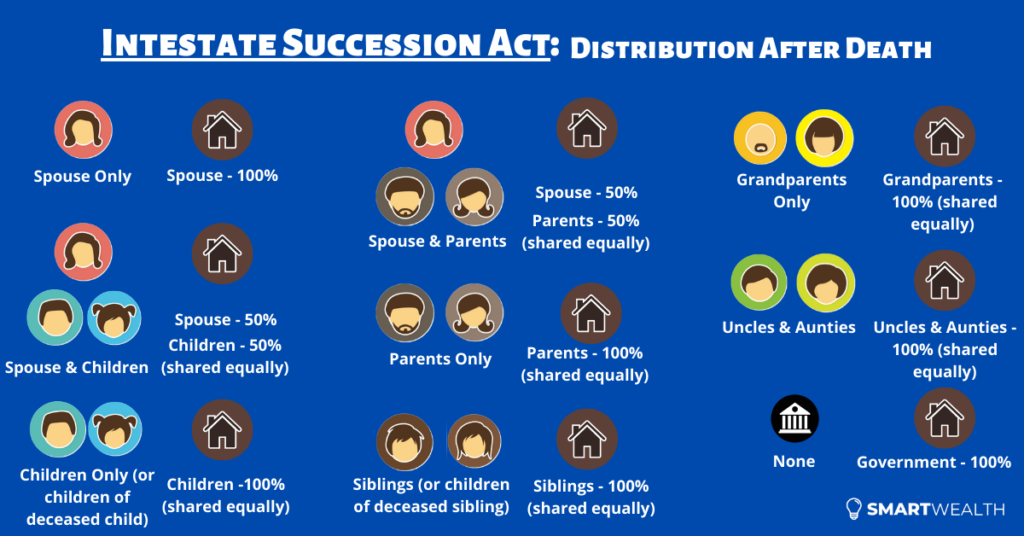
If you’re a Muslim, this doesn’t apply to you. Your estate is instead distributed under Muslim inheritance law (faraid).
Here’s the part most homeowners miss: how your property is owned can override your will entirely, and this is decided the moment you buy it, not when you die.
| Ownership type | What happens when an owner dies | Can a will override it? |
|---|---|---|
| Joint Tenancy | Passes automatically to the surviving co-owner | No |
| Tenancy-in-Common | Becomes part of the estate, distributed by will or the Act | Yes |
| Sole Ownership | Becomes part of the estate, distributed by will or the Act | Yes |
If you’re not sure how your own property is held, it’s worth checking.
This also means that if you want your will to have a say over your share of a jointly-held property, you need to act before you die, not after. You can do this by “severing” the joint tenancy while you’re still around, which converts your share into a tenancy-in-common. Once severed, your portion becomes part of your estate, and your will governs it like any other asset. It’s a straightforward step, but one most joint owners never think to take.
Who Can Actually Keep an Inherited Property
Inheriting a property and being allowed to keep it are two different things, and that trips up a lot of families. HDB has its own eligibility rules on top of whatever your will says.
A few things worth knowing:
- If your heir already owns an HDB flat and inherits another one, they can’t keep both. One usually has to be sold within a set period, though HDB can grant more time on appeal if a genuine effort to sell is under way.
- If they own private property and inherit an HDB flat, whether they can keep both depends on when the flat was bought. Flats purchased before 30 August 2010 without HDB grants can generally be kept alongside the private property once the MOP is met. Flats bought after that date usually mean a choice has to be made between the two.
- If they own an HDB flat and inherit private property, they can typically keep both once the MOP is met.
- If your heir is single, they’ll need to meet HDB’s Single Singapore Citizen Scheme criteria, including being 35 or older, to inherit and retain an HDB flat in their own name.
If you’re planning to leave a property to someone who already owns a home, or who’s single, it’s worth finding out where they stand now.
Do You Need to Pay Tax on an Inherited Property?
Let’s start with the good news: Singapore abolished estate duty in 2008. There’s no inheritance tax here, so this isn’t something your heirs need to plan around.
That doesn’t mean your property passes on entirely free of cost, though.
Stamp duty generally doesn’t apply when a property passes via a will or the Intestate Succession Act. Seller’s Stamp Duty could apply if your heirs sell soon after, though the clock for this starts from when you first bought the property, not when they inherit it, so it’s often already passed by then.
Property tax continues as normal, based on the property’s value, whether or not anyone lives in it. Rates are progressive and depend on whether the property is owner-occupied, ranging from 0% to 32% for owner-occupied homes and 12% to 36% for properties that aren’t, as of 2026. A high-value inherited property can mean a genuinely higher yearly bill, even without any rental income coming in.
An outstanding mortgage doesn’t automatically pass to your heirs, but if they want to take over the loan, the bank will assess their finances first against the Total Debt Servicing Ratio, capped at 55% of gross monthly income as of 2026. For HDB flats, the Home Protection Scheme usually pays off the loan when you pass away, so check that your cover is active. Private property owners should check whether they have similar mortgage insurance.
QUICK CHECK
Can you answer these three questions?
1) If something happened to you tomorrow, how much would your family receive?
2) At 65, what monthly income will your savings and investments pay you?
3) If you never get round to a will, who inherits what, and in what proportion?
Most people manage one at best. Not because they're careless, but because nobody has shown them which order to tackle things in.
That order exists. Work through your finances in this sequence, from income and protection through to investments and estate planning.
How to Make Sure Your Property Passes On the Way You Want
The good news is that the most powerful thing you can do here is simple: write a will.
A valid will lets you decide who gets your property, rather than leaving it to the default rules covered earlier. It also spares your family the added stress of settling things without clear instructions.
Beyond naming your beneficiaries, a good will also appoints an executor, someone you trust to carry out your wishes and handle the practical side of settling your estate. Many people ask a family member, or a lawyer, to take on this role.
When the time comes, your family will need to apply for either a Grant of Probate (if you have a will) or a Grant of Letters of Administration (if you don’t), before your property can be formally transferred. This isn’t something you need to navigate now, MyLegacy@LifeSG has official guidance for your family when the time comes.
For now, your job is simpler: get a will in place, review it every few years, and keep it somewhere your family can actually find it.
Should Your Family Keep, Sell, or Split the Property?
Once everything else is settled, your heirs will eventually face a practical decision: what to actually do with the property.
There are a few routes open to them. Keeping the property and living in it makes sense if it has sentimental value, or if someone in the family genuinely needs somewhere to stay.
Renting it out is another option, though that comes with its own MOP and tenancy rules to work through.
Selling and splitting the proceeds tends to be the simplest route when there are multiple heirs and nobody particularly wants to live there. And where there’s more than one heir, one of them can buy out the others’ shares instead of forcing a sale, though everyone still needs to agree on a fair price. Some families sidestep this bind by leaving legacy insurance alongside the property, so there is ready cash to even things out without anyone having to sell.
There’s no universally right answer here, it depends on your family’s circumstances, and it’s worth having this conversation with them directly rather than leaving it for them to figure out.
One common point of confusion worth clearing up now: a CPF nomination is not a will. It only directs what happens to your CPF savings. It has no bearing on your property at all, that still follows your will (or the Intestate Succession Act) as covered earlier. Having done a CPF nomination doesn’t mean your estate planning is done.
Special Situations Worth Knowing About
A few situations come with materially different rules, and it pays to know the basics in case either applies to you or your heirs.
If your heir is a foreigner or PR: they usually can’t own landed property in Singapore, and would need approval from the Singapore Land Authority to keep an inherited landed property. Without approval, they’d generally need to dispose of it within a set deadline under the Residential Property Act, so you’ll want to confirm the exact timeframe with SLA directly for your family’s situation.
If your family follows Muslim inheritance law: your estate is distributed under faraid, and a will can only dispose of up to a third of the estate to non-heirs, the rest follows prescribed shares.
If either of these applies to your family, get specific advice rather than relying on the general rules covered earlier.
What Commonly Goes Wrong (And How to Avoid It)
The most common problem isn’t a legal one, it’s family disagreement. Disputes often arise not because anyone acted unfairly, but because expectations were never made clear while you were still around to clarify them.
An heir can also choose to decline an inheritance, for instance if it comes with more debt than it’s worth. This isn’t something to worry about now, just useful to know it’s an option.
Another common issue is families simply not knowing what assets exist in the first place, which properties, bank accounts, or insurance policies someone had. Keeping a simple, up to date list of what you own, alongside your will, makes this considerably easier for whoever is left to sort it out.
What’s striking is how avoidable most of this is. A clear will, paired with an honest conversation with your family while you’re still around to have it, heads off nearly everything that could otherwise go wrong. If you take one thing from this article, that’s probably it: this is one part of the future that’s almost entirely within your control.
What Should You Do Next?
Reading this is already a good start. Most people never get round to thinking about this at all.
Here’s a short checklist to work through:
- Confirm how your property is currently held (joint tenancy, tenancy-in-common, or sole ownership)
- Write a will if you don’t have one, or review it if it’s been a few years
- Check that your HPS or MRTA cover is active, so your mortgage doesn’t become a burden
- Check that your CPF nomination and your will are consistent with each other
- Have the conversation with your intended heirs, so nothing comes as a surprise later
None of this needs to happen today. But it’s worth putting a date in your diary to actually get it done, rather than leaving it for “another day” indefinitely. A couple of hours now could save your family months of stress later, and that’s a trade worth making.
For a fuller look at the other pieces of getting your affairs in order, from wills to lasting powers of attorney, see our complete guide to estate planning in Singapore.
BEFORE YOU GO
Articles can tell you what generally makes sense. They can't see your policies, your CPF, or your plans.
FullCircle is our comprehensive financial planning session. A licensed consultant goes through what you have, shows you the gaps and overlaps, and tells you what to prioritise across protection, retirement, and estate planning.
It's complimentary, takes about 45 minutes, and if nothing needs changing, we'll say so.