

You may have heard of the movie “Crazy Rich Asians”, which was set in Singapore. But how many people here are actually rich?
The exact amount of wealth needed to qualify as rich is subjective, but a million dollars remains the milestone most people picture. Singaporeans are in a good position to reach it. Incomes are high, there’s no capital gains tax, and being a financial hub gives residents access to a wide range of financial products and services.
So how many millionaires (and billionaires) call Singapore home in 2026?
Let’s find out.
Summary of Key Findings
- There are 244,000 US-dollar millionaires in Singapore as of 2025
- Singapore added 5,240 new millionaires in 2025, a growth of 2.2%
- Roughly 1 in 20 adults in Singapore is a millionaire, by SmartWealth’s calculation
- About 27,000 people in Singapore hold between US$5 million and US$100 million
- The average wealth per adult in Singapore is US$527,217, the 6th highest in the world
- The median wealth per adult is US$96,434, ranked 20th globally
- Separately, Forbes counts 55 billionaires in Singapore as of March 2026, up from 49 a year earlier
SIDE NOTE
A policy bought years ago. Savings in three places. A will that's still on the to-do list.
None of it is wrong. It's just not a plan yet.
There's an order that turns the pieces into one system, and it doesn't require becoming a finance expert. Here's the order, in 7 steps, so you know what to sort out first.
The Data We Looked At
The UBS Global Wealth Report is published every year and is one of the most comprehensive studies of personal wealth in the world. The 2026 edition, released on 30 June 2026, covers 56 markets that together hold over 92% of the world’s wealth.
Long-time readers may remember this as the Credit Suisse Global Wealth Report. UBS took over Credit Suisse in 2023 and has continued the publication, now in its 17th edition. The underlying data is compiled with PwC Switzerland, drawing on national statistical sources, central banks, and international bodies such as the IMF and the World Bank.
One important note: a “millionaire” in this report means someone with a net worth of US$1 million or more. Net worth counts everything you own (property, investments, cash, pension savings) minus everything you owe.
This article focuses on how many millionaires and billionaires there are and how Singapore compares internationally. For what the typical Singaporean is worth, read our article on the average net worth in Singapore instead.
There Are 244,000 Millionaires in Singapore
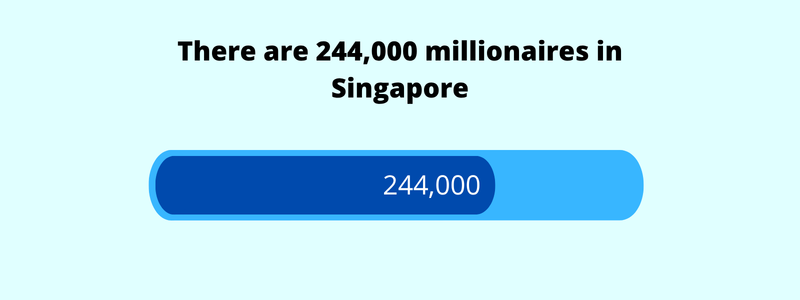
Singapore is home to 244,000 US-dollar millionaires as of 2025, based on the UBS Global Wealth Report 2026.
Despite the rising cost of living, the millionaire population here is still growing. Singapore added 5,240 new millionaires in 2025 alone, an increase of 2.2% from the year before.
It was a good year for millionaires everywhere. For the first time, every one of the 56 markets UBS tracks had more millionaires at the end of 2025 than at the start.
Here’s how Singapore’s 244,000 break down:
| Wealth band | Number of people |
|---|---|
| US$1 million to US$5 million | About 217,000 (estimate) |
| US$5 million to US$100 million | 27,000 |
| Total (US$1 million or more) | 244,000 |
Note: the US$1 million to US$5 million figure is our estimate, UBS’s 244,000 total minus the 27,000 it reports in the US$5 million to US$100 million band.
UBS calls those with US$1 million to US$5 million “everyday millionaires”, and they make up the vast majority here, as they do worldwide. The report notes that owner-occupied property is the single biggest asset for most people at this level, and that rising property valuations propel many into millionaire status without any actual increase in their disposable income. With HDB resale flats now regularly crossing the million-dollar mark, plenty of Singaporeans are technically millionaires without feeling like one.
The higher tiers have been growing quickly for a long time. Since 2000, the number of people in Singapore holding US$5 million to US$10 million has grown at a compound annual rate of 8.0%, with the US$10 million to US$50 million and US$50 million to US$100 million groups close behind at 7.6% and 7.3%. All three rates are at or above the world average, and the collective wealth of these groups has compounded at 9.4% to 9.6% a year over the same 25 years.
Why the Millionaire Count Fell From 332,000
If you’ve read earlier versions of this article, or older news reports, you may remember a much bigger number: over 330,000 millionaires. The lower figure of 244,000 doesn’t mean Singapore’s wealthy suddenly lost their fortunes. UBS changed how it counts millionaires.
An earlier version of this article cited 332,491 millionaires, from the 2023 edition published under Credit Suisse, and the 2025 edition still estimated 331,000. Then the 2026 edition reworked its methodology, including changes to what UBS calls its Millionaire Index. UBS states this plainly in its methodology notes. It routinely revisits the data and methods used to estimate millionaire numbers, covering both current and historic data, so the figures are not comparable with previous editions. On the new basis, the 2024 figure works out to around 238,800, rising to 244,000 in 2025.
This was a global recount, not a Singapore problem. Switzerland’s millionaire count, for example, fell from about 1,119,000 to 944,000 across the same two editions. Meanwhile, Singapore’s average wealth per adult actually rose to US$527,217 in 2025, from US$441,596 a year earlier.
It also means an older forecast has been overtaken. Previous editions projected Singapore would have 437,000 millionaires by 2025. That projection was made under the old methodology, so it no longer applies. On the current basis, the millionaire population reached 244,000 in 2025, and historically, the trend has still been upwards.
Roughly 1 in 20 Adults in Singapore Is a Millionaire
About 5% of Singapore’s adult population are US-dollar millionaires as of 2025, or roughly 1 in 20 adults.
The UBS report doesn’t publish a density figure for Singapore, so this is SmartWealth’s calculation: 244,000 millionaires against an adult population of just over five million. That counts every adult, the same basis UBS uses for all countries. Because Singapore’s adult population includes a large non-resident workforce with little wealth here, the share among citizens and permanent residents is considerably higher.
Globally, only 1.5% of adults hold more than US$1 million in wealth, which puts Singapore at around three times the world average. UBS’s density figures for other markets give a sense of where we sit: in Luxembourg the ratio is close to 1 in 6, in Hong Kong roughly 1 in 10, in the United States and the Netherlands nearly 9%, and in the UK and France around 4.5%.
By headcount, here’s how Singapore compares with selected markets:
| Market | Number of US-dollar millionaires (2025) |
|---|---|
| United States | 23,627,000 |
| Mainland China | 5,305,000 |
| Japan | 2,902,000 |
| Germany | 2,648,000 |
| United Kingdom | 2,428,000 |
| Australia | 1,634,000 |
| Switzerland | 944,000 |
| Taiwan | 772,000 |
| Hong Kong | 628,000 |
| Singapore | 244,000 |
For a country of Singapore’s size, 244,000 is a remarkable count: not far off Brazil’s 386,000, from a population more than 30 times larger. UBS itself notes that millionaire numbers depend less on economic might than on home ownership, private retirement savings, and tax breaks for investing, all of which Singapore has plenty of. Financial assets make up 63.8% of gross wealth here, with household debt a modest 11.8%.
QUICK CHECK
Can you answer these three questions?
1) If something happened to you tomorrow, how much would your family receive?
2) At 65, what monthly income will your savings and investments pay you?
3) If you never get round to a will, who inherits what, and in what proportion?
Most people manage one at best. Not because they're careless, but because nobody has shown them which order to tackle things in.
That order exists. Work through your finances in this sequence, from income and protection through to investments and estate planning.
How Many Billionaires Are There in Singapore?
There are 55 billionaires in Singapore as of March 2026, according to the Forbes World’s Billionaires List. That’s up from 49 the year before, and more than double the count from just four years ago.
Topping the Singapore list is Jason Chang, with a net worth of US$14.2 billion, though his fortune comes from Taiwanese semiconductor group ASE rather than a homegrown business.
The UBS report counts 3,302 billionaires worldwide as of April 2026 but doesn’t publish a figure for individual markets like Singapore, which is why we use Forbes here. Henley & Partners, which measures only liquid investable wealth, counts 30 billionaires residing in Singapore in its 2025 cities report.
If you’d like to see who the wealthiest Singaporeans are and how they built their fortunes, we cover them in our article on the richest people in Singapore.
Why Different Reports Give Different Numbers
You may see headlines quoting anywhere from 240,000 to over 330,000 millionaires in Singapore. The numbers differ because each report measures something different:
- UBS Global Wealth Report: total net worth, meaning financial assets plus real assets (mainly housing) minus debts. Funded pension assets are included, which matters in Singapore because CPF is a fully funded scheme. This is the broadest measure and the one we use.
- Henley & Partners (World’s Wealthiest Cities): liquid investable wealth only, such as cash and listed investments. Its 2025 report counts 242,400 millionaires in Singapore and ranks us the world’s 4th wealthiest city.
- Forbes: documented billionaires only, based on publicly traceable stakes and assets.
The UBS and Henley figures happen to be close this year (244,000 versus 242,400), but that’s coincidence rather than agreement. They measure different things, on different dates, at the city versus country level.
Whichever measure you use, Singapore ranks among the world’s top wealth hubs for its size.
The Average Millionaire vs the Median Singaporean
Averages hide a lot. The average wealth per adult in Singapore is US$527,217 (about S$683,600), but the median, the person exactly in the middle, holds US$96,434. The average is more than five times the median.
That gap exists because the very wealthy pull the average up. Singapore’s wealth Gini coefficient, a standard measure of how unevenly wealth is spread, stands at 0.69 in 2025. That places us 19th most unequal of the 56 markets in the report, slightly above Switzerland (0.68) but well below the United States (0.77). We explore this in more detail in our article on income inequality in Singapore.
So if your net worth is nowhere near half a million US dollars, you’re in good company. Most Singaporeans aren’t.
Why Are There So Many Millionaires in Singapore?
Singapore has extremely limited land and few natural resources. Its wealth was built deliberately, through policies designed to grow the economy and, in turn, the prosperity of the people living here.
The country was primed to attract multinational companies and wealthy individuals from around the world: business-friendly rules, low tax rates, a politically stable environment, and freedom from natural disasters. That has meant more good jobs, more wealth created locally, and a steady inflow of already-wealthy newcomers.
Add to that a high home ownership rate in a property market that has appreciated over decades, and forced savings through CPF, and you get a population where crossing the US$1 million mark is far more common than in most countries.
How to Be a Millionaire in Singapore?
For most people, the realistic path to a million is some combination of career income, steady investing, property, and CPF, compounded over time. There’s no shortcut, but the routes are well worn.
Most of the richest people in Singapore built their wealth through business, taking on far more risk than the average person. That’s why they’re at the very top. But many businesses fail, and that route isn’t for everyone.
The more predictable path is through employment and steady investing. Investing in your career, taking ownership of the value you bring, tends to raise your income over time, and at a household level, two earners saving together reach the mark faster. With greater savings, you can invest, start something small on the side, or both.
And don’t forget protection. A serious illness or the loss of an income earner can undo years of accumulation, which is why cover such as term insurance or whole life insurance matters for you and your loved ones on the way up.
Doing these things may not get you into Forbes. In my opinion, though, they’re a far more reliable way to end up a millionaire in Singapore than chasing a big, risky win.
BEFORE YOU GO
Articles can tell you what generally makes sense. They can't see your policies, your CPF, or your plans.
FullCircle is our comprehensive financial planning session. A licensed consultant goes through what you have, shows you the gaps and overlaps, and tells you what to prioritise across protection, retirement, and estate planning.
It's complimentary, takes about 45 minutes, and if nothing needs changing, we'll say so.