

Cancer is the number one cause of death in Singapore. It has been for a long time.
That is a sobering fact, but it is one every Singaporean should know. Because the more you understand about cancer, the better placed you are to take action: getting screened earlier, knowing what to watch for, and making sure you have the right financial protection in place.
In this article, we look at the most important cancer statistics in Singapore, updated with the latest national data. We have written this for the average person, not a medical professional, so you will not find heavy jargon here.
Read on for the full picture.
Key Cancer Statistics in Singapore
- Cancer is the leading cause of death in Singapore, accounting for 26.5% of all deaths
- An estimated 1 in 4 Singaporeans will develop cancer by the age of 75
- Cancer cases have grown more than 7 times since the 1960s, with around 50 new diagnoses and 17 deaths every day
- The median age at cancer diagnosis is 69.1 years for males and 64.6 years for females
- The top three cancers in men are prostate, colorectal, and lung
- The top three cancers in women are breast, colorectal, and lung
- Cancer is increasingly affecting younger Singaporeans, with the fastest-growing rates seen in those under 50
- The five-year survival rate for all cancers has improved from 22.6% in 1978-1982 to 61.4% in 2019-2023
- Cancer accounts for the vast majority of life insurance claims in Singapore
SIDE NOTE
A policy bought years ago. Savings in three places. A will that's still on the to-do list.
None of it is wrong. It's just not a plan yet.
There's an order that turns the pieces into one system, and it doesn't require becoming a finance expert. Here's the order, in 7 steps, so you know what to sort out first.
The Source of Our Data
The data in this article comes primarily from the Singapore Cancer Registry (SCR) Annual Report 2023, published in December 2025 by the National Registry of Diseases Office (NRDO).
The SCR has been collecting cancer data in Singapore since 1968. Reporting to the registry is mandatory under the National Registry of Diseases Act, meaning healthcare providers are legally required to submit cancer diagnoses. This makes the dataset one of the most complete and reliable cancer records.
The 2023 report covers all cancers diagnosed in Singapore from 1 January 1968 to 31 December 2023. When the report presents “2019-2023” figures, it is grouping five years of data together. This is standard practice in cancer reporting because it smooths out year-to-year fluctuations and gives a more stable picture of trends.
Unless otherwise stated, the statistics in this article reflect the most recent 2019-2023 period. Where we compare against earlier periods, the relevant years are stated.
Where we reference insurance claims data and treatment costs, these come from external sources and we have noted this clearly in the relevant sections.
This page will be updated regularly to reflect the latest information.
13 Cancer Statistics in Singapore (2026)
Here are the most important findings from the latest data.
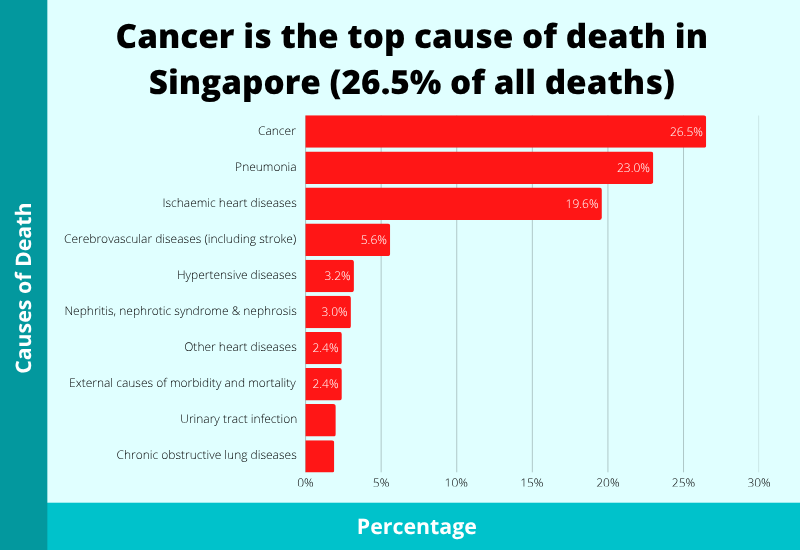
1) Cancer is the leading cause of death in Singapore, responsible for 26.5% of all deaths
In 2024, cancer accounted for 26.5% of all deaths in Singapore. That is more than one in four deaths.
| Cause | Percentage of Deaths (2024) |
|---|---|
| Cancer | 26.5% |
| Pneumonia | 23.0% |
| Ischaemic heart diseases | 19.6% |
| Cerebrovascular diseases (including stroke) | 5.6% |
| Hypertensive diseases | 3.2% |
| Nephritis, nephrotic syndrome & nephrosis | 3.0% |
| Other heart diseases | 2.4% |
| External causes of morbidity and mortality | 2.4% |
| Urinary tract infection | 2.0% |
| Chronic obstructive lung diseases | 1.9% |
Cancer’s share rose from 24.6% in 2023 to 26.5% in 2024. Either way, cancer remains firmly at the top of Singapore’s leading causes of death.
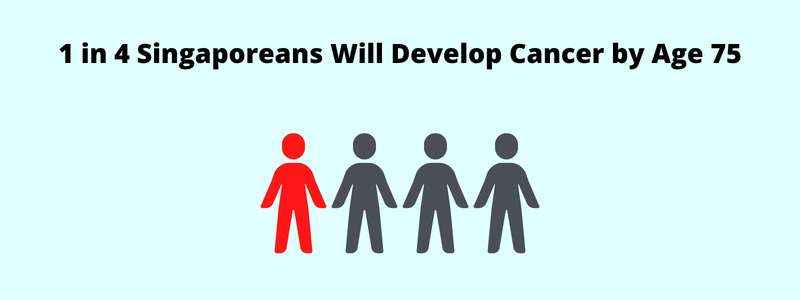
2) 1 in 4 Singaporeans will develop cancer by age 75
The estimated lifetime risk of developing cancer by the age of 75 is 26.8% for males and 26.2% for females.
In plain terms: roughly 1 in 4 Singaporeans can expect to be diagnosed with cancer before they turn 75.
This does not mean you will definitely get cancer. But it does mean that planning for it, whether through regular screening, lifestyle choices, or insurance coverage, is a practical decision, not an overcautious one.
3) Cancer cases have increased sevenfold since the 1960s, with around 50 new diagnoses every day
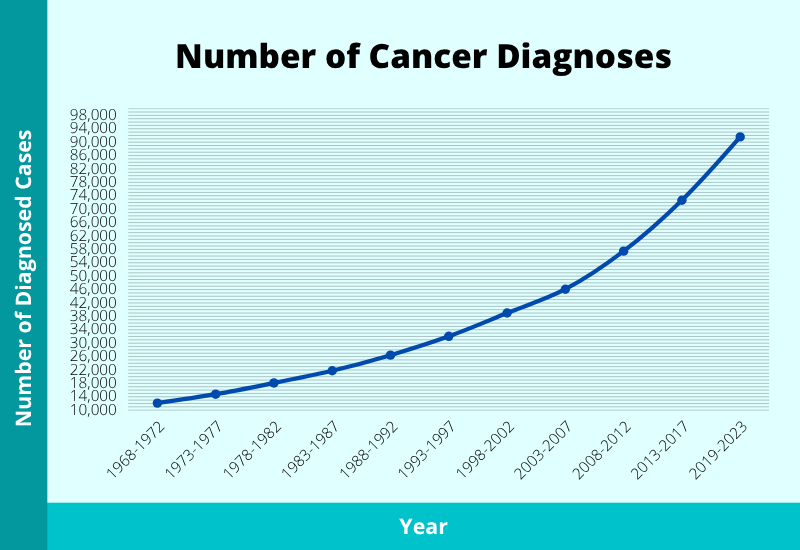
In the five-year period from 1968 to 1972, 12,113 Singaporeans were diagnosed with cancer. In the most recent five-year period from 2019 to 2023, that number was 91,574, a more than sevenfold increase.
That works out to roughly 18,314 new cases per year, or about 50 new diagnoses every single day.
Over the same period, 30,979 Singaporeans died from cancer: 16,802 males and 14,177 females. That works out to roughly 17 deaths from cancer every day.
The crude incidence rate (raw cases per 100,000 population) has roughly tripled for males and quadrupled for females since the 1960s. A large part of this rise is explained by Singapore’s ageing population. When researchers adjust for this using the age-standardised incidence rate (ASIR), the picture is more stable: the ASIR for males has remained relatively steady, while the ASIR for females has risen. The ASIR adjusts for the age structure of a population, so you can fairly compare cancer rates over time or across countries without older populations skewing the numbers upward.
The median age at diagnosis was 69.1 years for males and 64.6 years for females. The median age is simply the midpoint: half of all cancer diagnoses happen before this age, and half happen after. It is a useful way to understand who is typically getting cancer, and it has been rising steadily over the decades as Singapore’s population ages.
4) The most common cancers in men are prostate, colorectal, and lung
Among males in Singapore, here are the ten most commonly diagnosed cancers:
| Rank | Cancer | No. of Cases | % of All Male Cancers |
|---|---|---|---|
| 1 | Prostate | 8,114 | 18.0% |
| 2 | Colorectal | 7,101 | 15.8% |
| 3 | Lung | 5,938 | 13.2% |
| 4 | Lymphoid neoplasms | 3,336 | 7.4% |
| 5 | Liver | 3,148 | 7.0% |
| 6 | Non-melanoma skin | 2,268 | 5.0% |
| 7 | Kidney | 1,867 | 4.2% |
| 8 | Stomach | 1,713 | 3.8% |
| 9 | Pancreas | 1,585 | 3.5% |
| 10 | Myeloid neoplasms | 1,573 | 3.5% |
One notable shift: prostate cancer has moved to the top spot, overtaking colorectal cancer. Its incidence has risen sharply over the past three decades, partly due to increased awareness and more frequent testing.
Together, the top three cancers (prostate, colorectal, and lung) account for nearly half of all male cancer diagnoses.
5) The most common cancers in women are breast, colorectal, and lung
Among females in Singapore, here are the ten most commonly diagnosed cancers:
| Rank | Cancer | No. of Cases | % of All Female Cancers |
|---|---|---|---|
| 1 | Breast | 13,935 | 29.9% |
| 2 | Colorectal | 5,849 | 12.6% |
| 3 | Lung | 3,794 | 8.1% |
| 4 | Uterus | 3,424 | 7.3% |
| 5 | Lymphoid neoplasms | 2,463 | 5.3% |
| 6 | Ovary | 1,899 | 4.1% |
| 7 | Thyroid | 1,886 | 4.0% |
| 8 | Non-melanoma skin | 1,842 | 4.0% |
| 9 | Pancreas | 1,398 | 3.0% |
| 10 | Cervix | 1,146 | 2.5% |
Breast cancer remains far and away the most common cancer in women, accounting for nearly 30% of all female cancer cases. Almost 14,000 women were diagnosed with breast cancer over the five-year period. Its incidence has risen nearly fourfold since the late 1960s, though survival rates have improved dramatically over that time.
QUICK CHECK
Can you answer these three questions?
1) If something happened to you tomorrow, how much would your family receive?
2) At 65, what monthly income will your savings and investments pay you?
3) If you never get round to a will, who inherits what, and in what proportion?
Most people manage one at best. Not because they're careless, but because nobody has shown them which order to tackle things in.
That order exists. Work through your finances in this sequence, from income and protection through to investments and estate planning.
6) Cancer rates and patterns differ by ethnicity
Ethnicity plays a meaningful role in who gets cancer and how they fare.
The age-standardised incidence rates (ASIR) per 100,000 population were:
| Ethnicity | Male ASIR | Female ASIR |
|---|---|---|
| Chinese | 247.2 | 249.3 |
| Malay | 232.1 | 258.2 |
| Indian | 163.7 | 200.1 |
Indian males have the lowest cancer incidence by a significant margin. One notable trend: the Malay community has seen one of the steepest rises in cancer rates over the past five decades, with Malay females now recording a higher ASIR than Chinese females.
The top cancers also differ by ethnicity. Among Chinese males, prostate cancer is the most common. Among Indian males, colorectal cancer takes the top spot, with prostate a close second. Among Malay males, lung cancer is the most common. For all three ethnic groups in women, breast cancer is the most common by a wide margin.
7) Younger Singaporeans are getting cancer more often
We tend to think of cancer as a disease of old age.
While it remains far more common in older adults, a growing trend is worth paying attention to. The most rapid increases in age-specific incidence rates in recent decades have been observed among those under 50 years of age. Among males, the 30-39 age group has seen rising incidence rates. Among females, the 40-49 group has seen the sharpest increase.
Among young males under 30 in Singapore, the most common cancers were lymphoid neoplasms, testicular cancer, and myeloid neoplasms. Among young females under 30, lymphoid neoplasms, thyroid cancer, and ovarian cancer were most common.
The message is not to panic. But if you are in your 30s or 40s and have been putting off a health check, this is a nudge to prioritise it.
8) Lung cancer is the biggest cancer killer, even though it is not the most common
This is a critical distinction that many people miss.
The cancers that are most commonly diagnosed are not necessarily the ones that kill the most people.
Leading cancer deaths in men:
| Rank | Cancer | No. of Deaths | % of All Male Cancer Deaths |
|---|---|---|---|
| 1 | Lung | 4,033 | 24.6% |
| 2 | Colorectal | 2,429 | 14.8% |
| 3 | Liver | 2,039 | 12.4% |
| 4 | Pancreas | 1,264 | 7.7% |
| 5 | Prostate | 1,157 | 7.0% |
Leading cancer deaths in women:
| Rank | Cancer | No. of Deaths | % of All Female Cancer Deaths |
|---|---|---|---|
| 1 | Breast | 2,426 | 17.9% |
| 2 | Colorectal | 2,162 | 15.9% |
| 3 | Lung | 2,157 | 15.9% |
| 4 | Pancreas | 1,096 | 8.1% |
| 5 | Liver | 815 | 6.0% |
Lung cancer causes nearly 1 in 4 male cancer deaths in Singapore, despite being only the third most commonly diagnosed cancer. That gap between incidence rank and mortality rank tells you everything about how deadly it is, and how late it tends to be caught.
9) Cancer survival rates have improved dramatically over the decades
Here is the good news.
The overall five-year survival rate for cancer in Singapore has improved remarkably over the past five decades. Across both sexes combined, it rose from 22.6% in 1978-1982 to 61.4% in 2019-2023.
Among males, it rose from 13.2% in 1973-1977 to 57.8% in 2019-2023.
Among females, it rose from 28.0% to 64.7% over the same period.
Women consistently have better survival rates than men across all time periods. The improvement reflects advances in treatment, better access to screening, and earlier detection for several common cancers.
That said, survival rates vary enormously depending on which cancer you have.
10) Some cancers are far more survivable than others
The five-year survival rate, meaning the proportion of patients still alive five years after diagnosis, tells a very different story depending on the type of cancer.
Five-year survival rates for the most common cancers in men:
| Cancer | 5-Year Survival Rate |
|---|---|
| Non-melanoma skin | 93.8% |
| Prostate | 90.3% |
| Kidney | 67.4% |
| Colorectal | 64.2% |
| Lymphoid neoplasms | 62.6% |
| Myeloid neoplasms | 48.1% |
| Stomach | 37.5% |
| Liver | 27.8% |
| Lung | 24.2% |
| Pancreas | 12.9% |
Five-year survival rates for the most common cancers in women:
| Cancer | 5-Year Survival Rate |
|---|---|
| Non-melanoma skin | 97.3% |
| Thyroid | 89.8% |
| Breast | 84.2% |
| Uterus | 73.3% |
| Colorectal | 64.6% |
| Lymphoid neoplasms | 63.0% |
| Cervix | 62.4% |
| Ovary | 45.3% |
| Lung | 40.7% |
| Pancreas | 15.2% |
Prostate cancer in men and thyroid and breast cancers in women all have survival rates above 84%. Pancreatic cancer sits at the opposite end, with fewer than 1 in 7 patients alive at five years.
The difference between highly survivable and poorly survivable cancers often comes down to one thing: how early the cancer was detected.
11) Stage at diagnosis makes a dramatic difference
Cancer is staged from I to IV. Stage I means the tumour is small and localised. Stage IV means it has spread to other parts of the body. The earlier the stage at diagnosis, the better the chances of survival.
The table below shows what proportion of cases are diagnosed at each stage for the major cancers in Singapore.
Stage distribution for major cancers in men:
| Cancer | Stage I | Stage II | Stage III | Stage IV |
|---|---|---|---|---|
| Prostate | 14.6% | 30.6% | 25.4% | 29.4% |
| Colorectal | 20.1% | 21.3% | 33.0% | 25.6% |
| Lung | 17.2% | 5.2% | 17.4% | 60.3% |
| Liver | 36.0% | 15.5% | 24.1% | 24.4% |
| Kidney | 48.1% | 6.3% | 17.6% | 28.0% |
| Stomach | 27.1% | 10.8% | 18.9% | 43.3% |
| Pancreas | 12.8% | 13.0% | 17.0% | 57.1% |
Stage distribution for major cancers in women:
| Cancer | Stage I | Stage II | Stage III | Stage IV |
|---|---|---|---|---|
| Breast | 56.3% | 20.3% | 12.6% | 10.8% |
| Colorectal | 19.4% | 23.8% | 30.9% | 25.9% |
| Lung | 26.7% | 4.4% | 9.3% | 59.6% |
| Uterus | 65.9% | 6.6% | 14.5% | 13.0% |
| Ovary | 46.7% | 8.6% | 23.8% | 20.9% |
| Thyroid | 78.8% | 12.8% | 2.1% | 6.3% |
| Pancreas | 14.2% | 14.0% | 17.3% | 54.5% |
| Cervix | 34.8% | 21.6% | 22.9% | 20.7% |
The contrast is striking. Thyroid cancer in women has 78.8% of cases caught at Stage I, and breast cancer has 56.3% caught at Stage I. Both cancers have high survival rates. Lung and pancreatic cancers, on the other hand, are caught at Stage IV more often than not, and both sit at the bottom of the survival table.
This is not a coincidence. Stage at diagnosis and survival outcomes are directly linked.
This is why cancer screenings are not something to keep putting off. Going for your screenings can genuinely save your life.
12) Cancer dominates life insurance claims in Singapore
If you hold a life insurance policy in Singapore, or are thinking about getting one, here is something important to know.
Cancer is by far the leading cause of life insurance claims.
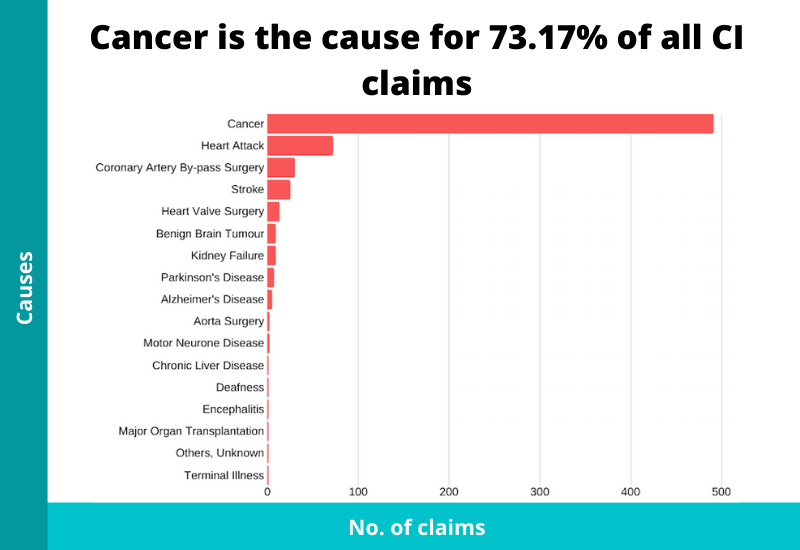
Based on our analysis of Income Insurance claim data, cancer accounted for approximately 73% of all critical illness claims.
For death claims, cancer was responsible for around 40%.
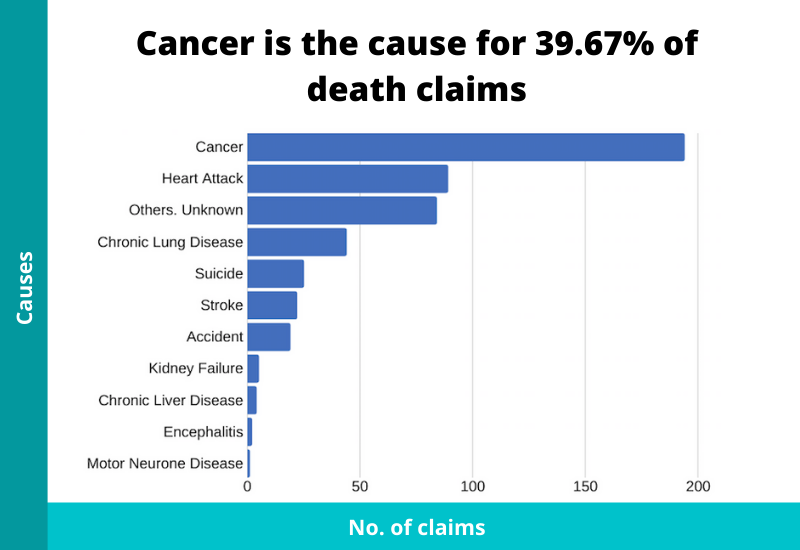
The implication is straightforward. Cancer is the condition most likely to trigger a claim on your life or critical illness policy. Having a critical illness plan that pays out a lump sum on diagnosis means you are not forced to make financial decisions at the worst possible time.
Note: The figures in this section are from SmartWealth’s own analysis of life insurance claim data, not the Singapore Cancer Registry. For the full breakdown, see our life insurance claim statistics article.
13) Cancer treatment in Singapore can cost hundreds of thousands of dollars
Cancer treatment in Singapore is not cheap.
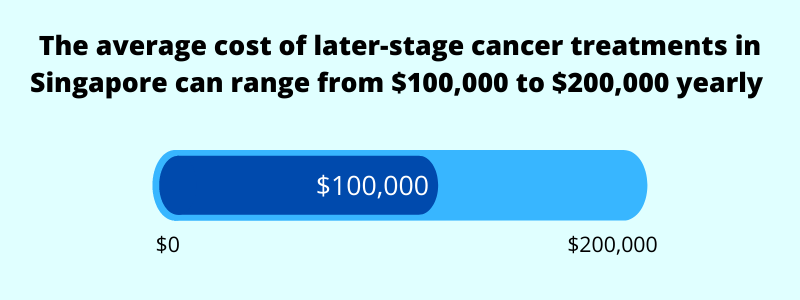
For late-stage cancers, annual treatment costs can run from $100,000 to $200,000 or more, depending on the type of cancer and whether targeted therapies or immunotherapy are required. These costs can compound over multiple years of treatment.
Even for early-stage cancers, surgery, radiotherapy, chemotherapy, and follow-up care can result in total bills running into the tens of thousands of dollars.
Singapore’s MediShield Life and Integrated Shield Plans (IPs) will cover a portion of hospitalisation and treatment costs.
However, for advanced cancer requiring expensive drugs, out-of-pocket expenses can still be substantial even with insurance. This is one reason why a CI plan is worth having separately from your hospitalisation coverage.
Note: Treatment cost estimates are sourced externally and are not from the Singapore Cancer Registry. Costs vary by cancer type, stage, and treatment method, and have been rising with medical inflation.
What’s Next?
Cancer is not going away. But there is real reason for optimism.
Five-year survival rates in Singapore have improved dramatically over the past 50 years. Treatments are better. More cancers are being caught earlier. And there is more that you can do to protect yourself than ever before.
Here is what matters most.
- Go for your screenings. Early detection saves lives. Do not put them off.
- Know your body. Symptoms like a persistent cough, unexplained weight loss, blood in your stool, unusual lumps, or changes that last more than a few weeks deserve medical attention.
- Know your family history. If close relatives have had certain cancers, your own risk may be higher. Speak with your doctor about whether additional screening is appropriate for you.
- Make sure your financial protection is in place. Cancer treatment is expensive, and costs have risen significantly with medical inflation. A critical illness plan pays out a lump sum on diagnosis, giving you financial flexibility when you need it most. A term insurance policy ensures your family is taken care of if the worst happens.
Given that 1 in 4 Singaporeans will develop cancer in their lifetime, having the right coverage is not excessive caution. It is simply good planning, and it works best as part of a protection plan you’ve thought through as a whole rather than a policy bought in isolation.
BEFORE YOU GO
Articles can tell you what generally makes sense. They can't see your policies, your CPF, or your plans.
FullCircle is our comprehensive financial planning session. A licensed consultant goes through what you have, shows you the gaps and overlaps, and tells you what to prioritise across protection, retirement, and estate planning.
It's complimentary, takes about 45 minutes, and if nothing needs changing, we'll say so.